Nineteen seventy-six is a year remembered well. While most years cannot be tied to a specific memory, America’s Bicentennial is connected to the experiences of many who grew up during the era. The celebration seemed to touch everything. There were special soda cans, cereal boxes, parades, speeches, coins, and commemorative products of every description.
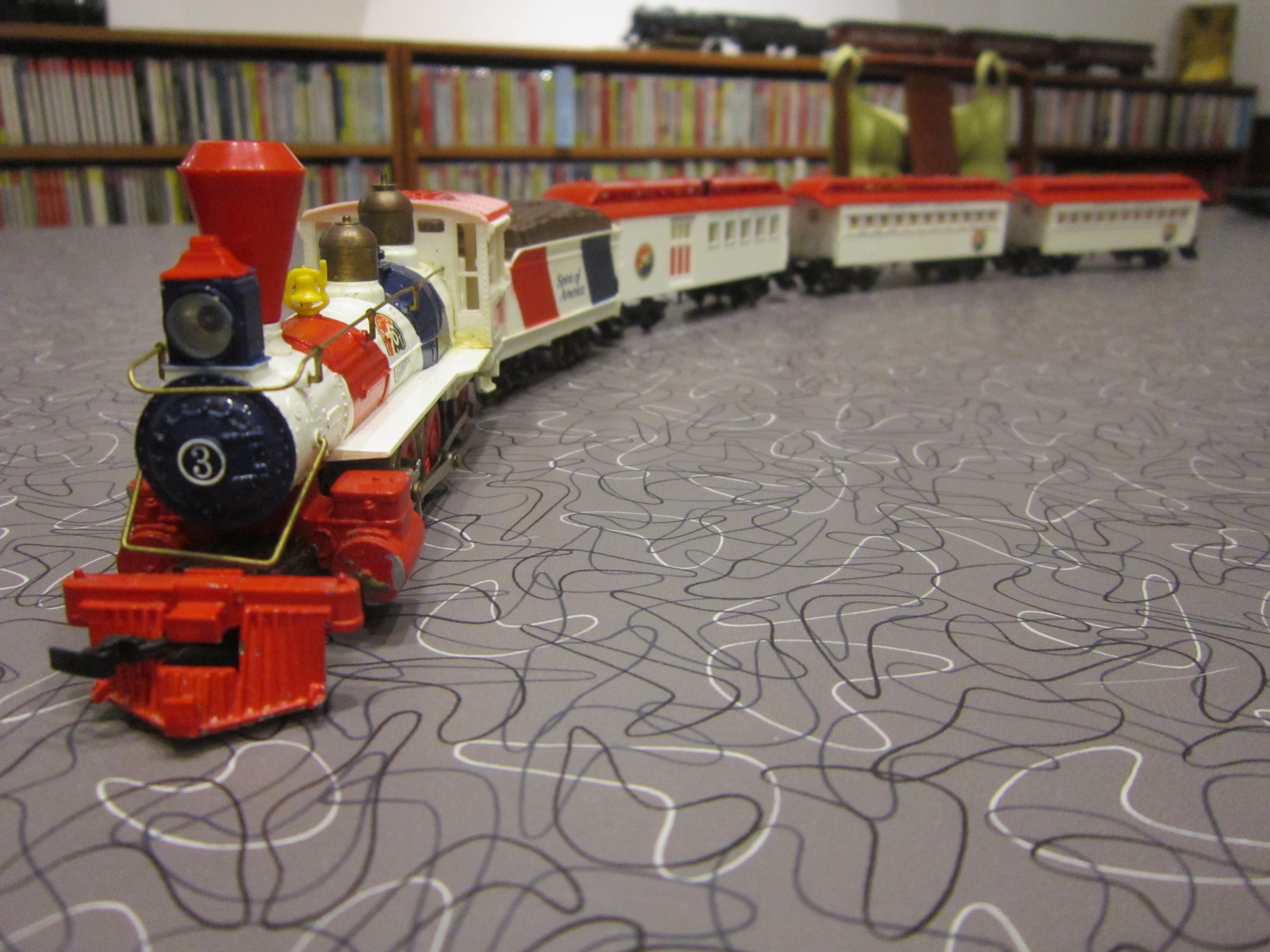
I do not remember most of those things firsthand. I don’t recall the patriotic advertising campaigns or the endless red, white, and blue packaging. But I know it was Christmas 1976 when I arrived at my grandmother’s house and found a Bicentennial train set circling the tree.
That train was one of many toys that came and went during childhood, but it is perhaps the only one I can tie to a specific year. It remains the reason I have a fondness for Bicentennial collectibles today. Recently, while wandering through an antique mall, a Bicentennial decanter caught my eye. It sat quietly on a shelf with a $25 price tag attached. Had the Old Grand-Dad whiskey still been inside, the value might have exceeded $500. Empty, it was simply another relic from a year when America seemed determined to commemorate itself.

My other vivid memory from that time may be from the spring of 1976 or 1977. My grandmother had saved Bicentennial quarters and tucked them into plastic Easter eggs. The special reverse design featuring a colonial drummer made them seem different from ordinary coins. To a child, they felt like treasure. Some of those quarters are still in circulation today. They remain worth twenty-five cents, although inflation has reduced what that quarter can buy.
The train set itself was hardly unusual. A Tyco HO-scale Bicentennial train set, such as the popular Spirit of America set, typically retailed for between thirty and sixty dollars. Adjusted for inflation, that would be roughly equivalent to $175 to $350 today. Interestingly, the locomotive alone can now sell for $80 to $200 on the collector market. Like many collectibles, nostalgia often proves more valuable than inflation.


What makes Bicentennial memorabilia fascinating is its sheer scale. Americans did not simply celebrate the nation’s two-hundredth birthday. They purchased it. Manufacturers released commemorative watches, toys, stamps, automobiles, and household goods. Eagle-themed wall hangings appeared in living rooms. Needlework samplers and patriotic quilts decorated homes. Colonial revival furniture enjoyed renewed popularity. Bicentennial clocks ticked away on mantels across the country.
Looking back, the Bicentennial may have been America’s first truly modern collectible craze. Previous generations collected stamps, coins, and souvenirs, but the Bicentennial transformed nearly every consumer product into a potential keepsake. Companies encouraged Americans to save what they bought because one day it might become valuable. Millions did exactly that.
The irony, of course, is that so many people preserved these items that most never became particularly rare. Antique malls today are filled with commemorative plates, mugs, decanters, bells, and countless other Bicentennial objects. Most remain affordable. Their value lies less in scarcity than in what they represent.
For those who remember 1976, these objects are reminders of a unique moment when the entire country paused to celebrate a milestone. For those who came later, they offer a glimpse into how Americans viewed their own history at the nation’s two-hundredth birthday.
And every now and then, among the shelves of an antique mall, one of those objects still has the power to stop us in our tracks. For me, it is usually a train painted in red, white, and blue, forever circling a Christmas tree in 1976.
Tyco “Spirit of America” Train Sets
Manufacturer: Tyco Industries
Notes: Among the most recognizable Bicentennial train sets. Complete boxed sets command the highest prices, but locomotives alone remain popular with collectors. Original packaging can significantly increase value.
Lionel Bicentennial Locomotives and Cars
Manufacturer: Lionel
Notes: Lionel produced several patriotic-themed pieces in O gauge. Look for original boxes and limited-production items.
Bicentennial Quarters, Half Dollars, and Dollars
Manufacturer: United States Mint
Notes: Circulated examples remain common, but silver-clad proof sets and unopened mint sets are more desirable. Many people saved them, so condition matters.
Old Grand-Dad Bicentennial Decanters
Manufacturer: National Distillers
Notes: Empty examples are common. Unopened examples containing the original whiskey can bring substantially higher prices, depending on condition and provenance.
Jim Beam Bicentennial Bottles
Manufacturer: Jim Beam
Notes: One of the most prolific producers of commemorative decanters. Most empty examples are modestly priced, but unusual forms, limited editions, and sealed examples can be worth seeking out.
Avon Bicentennial Collectibles
Manufacturer: Avon
Notes: Produced everything from plates and bells to bottles and glassware. These remain plentiful but are excellent examples of how extensively the Bicentennial reached American households.
Coca-Cola Bicentennial Advertising
Manufacturer: Coca-Cola
Notes: Trays, glasses, signs, and special packaging remain popular. Store displays and advertising signs generally attract more collector interest than common commemorative glasses.
Bicentennial Watches
Manufacturers: Timex, Bulova, Elgin and others
Notes: Many were produced as commemorative gifts or promotional items. Original boxes and paperwork increase desirability.
United States Postal Service Bicentennial Stamp Sets
Manufacturer: U.S. Postal Service
Notes: First-day covers, commemorative stamp albums, and postal souvenirs remain affordable and are often found at estate sales.
Bicentennial Board Games and Toys
Manufacturers: Parker Brothers, Milton Bradley and others
Notes: Educational games, puzzles, and patriotic-themed toys are less commonly encountered today than many ceramic collectibles.
Railroad Bicentennial Memorabilia
Manufacturers: Various railroads including Chessie System, Seaboard Coast Line, and others
Notes: Railroads embraced the Bicentennial with special paint schemes and promotional merchandise. Calendars, posters, employee items, and model railroad versions often have strong collector followings.
Bicentennial Glassware
Manufacturers: Federal Glass, Libbey, Indiana Glass and others
Notes: Mugs, tumblers, and commemorative glasses are common but visually appealing. Sets and unusual designs are worth a closer look.
Colonial Revival Home Decor
Manufacturers: Numerous furniture and decorative arts companies
Notes: Eagle wall hangings, brass accessories, clocks, and patriotic decor were popular during the Bicentennial era. These pieces often blend into general Americana and can sometimes be overlooked by collectors.
Local and Regional Bicentennial Souvenirs
Manufacturers: Local historical societies, chambers of commerce, and civic groups
Notes: Often produced in small quantities for local celebrations. These can be far scarcer than nationally distributed collectibles and are frequently the most interesting finds.
Collector Tip: The Bicentennial’s greatest irony is that millions of Americans purchased and preserved commemorative items because they believed they would become valuable. As a result, many survive in large numbers today. The most desirable pieces are often not the ones people carefully stored away, but the advertising displays, local souvenirs, promotional items, and everyday objects that were used, enjoyed, and eventually discarded.



Leave a Reply