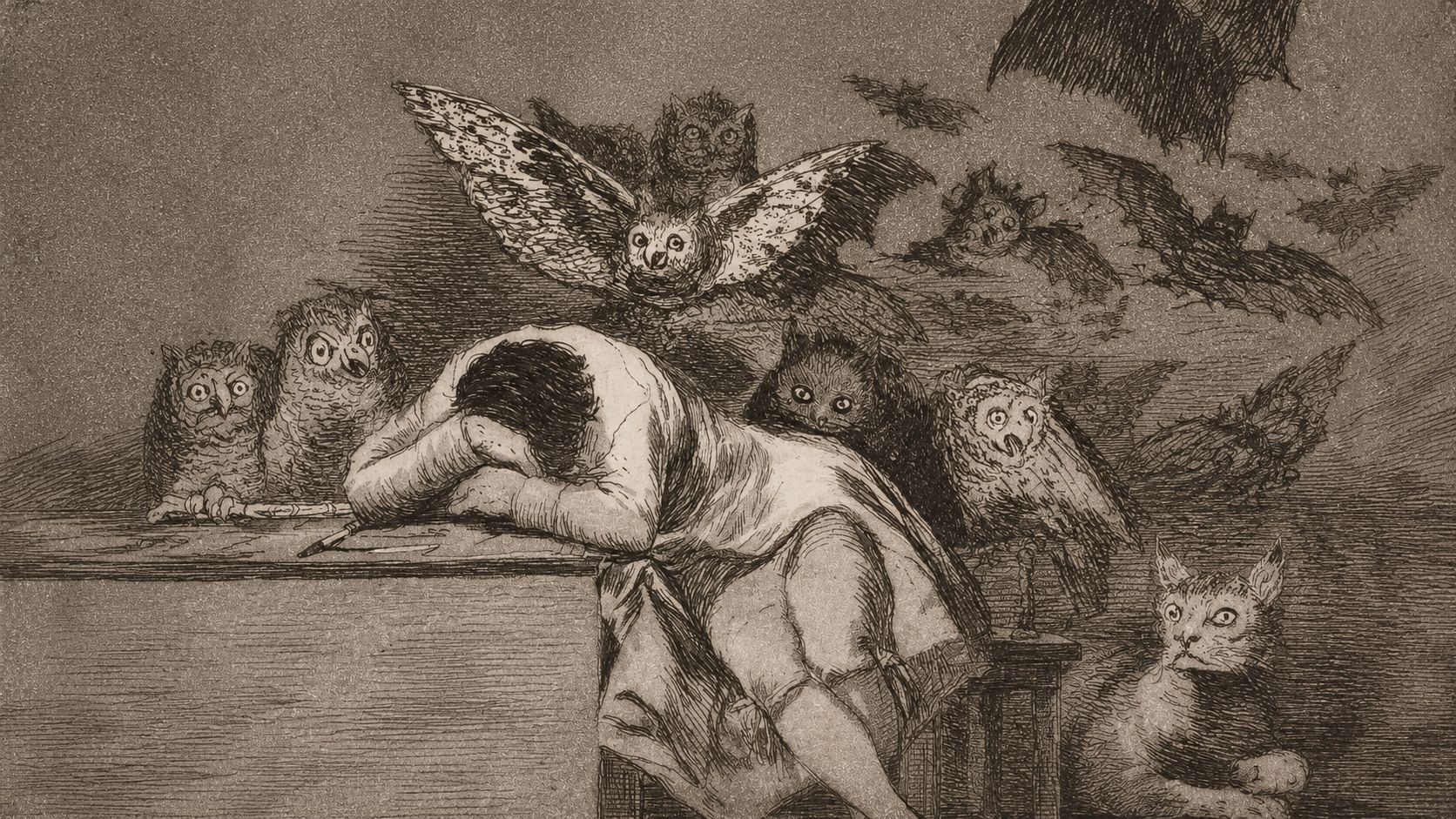
In 1799, Francisco Goya created an image that still feels unsettling more than two centuries later. The Sleep of Reason Produces Monsters was originally part of his satirical series Los Caprichos, a body of work criticizing superstition, corruption, and the failures of Spanish society. Yet this single print has endured because it feels larger, darker, and far more personal than political satire alone.
The image is deceptively simple. A sleeping figure collapses over a desk while owls, bats, and shadowy creatures swarm behind him. The title suggests a warning: when reason falls asleep, monsters emerge. But the print’s power lies in its ambiguity. These creatures are not invading from the outside world. They appear to rise from the sleeping figure himself, as though fear, madness, and irrationality were always present beneath the surface of consciousness.
For Goya, this was not an abstract idea. In 1792, he suffered a devastating illness that left him permanently deaf. The abrupt silence transformed his life and, increasingly, his art. Once celebrated as a court painter for the Spanish aristocracy, Goya turned inward after his illness, growing more skeptical of the society around him and more fascinated by the instability of the human mind.
Spain itself was caught between competing worlds. Enlightenment ideals of science and reason were spreading across Europe, yet Spain remained deeply shaped by rigid tradition, superstition, and institutional power. Goya saw both the promise and the limits of reason. His work became a visual confrontation with a society trapped between progress and fear.
That darkness only deepened in his later years. By the time Goya created the infamous Black Paintings, he was living in near isolation, covering the walls of his home with visions of madness, violence, and despair. The seeds of those later works already exist in The Sleep of Reason Produces Monsters. The print no longer feels like a social critique alone. It becomes a portrait of psychological terror.
What makes the image endure is its refusal to offer comfort. It is tempting to read the work as a straightforward defense of reason against ignorance. Yet Goya complicates that interpretation. The monsters emerge from the same mind that contains reason itself. The print suggests that rationality may not eliminate darkness so much as temporarily organize or suppress it.
More than two centuries later, Goya’s warning remains disturbingly modern. The image speaks not only to political irrationality or social fear, but to the fragile boundaries within the human mind itself. Reason may illuminate the world, but Goya reminds us that it never fully banishes the shadows waiting just beyond its reach.



Leave a Reply