Some mysteries survive because no one can solve them. Others survive because every generation invents a new answer.
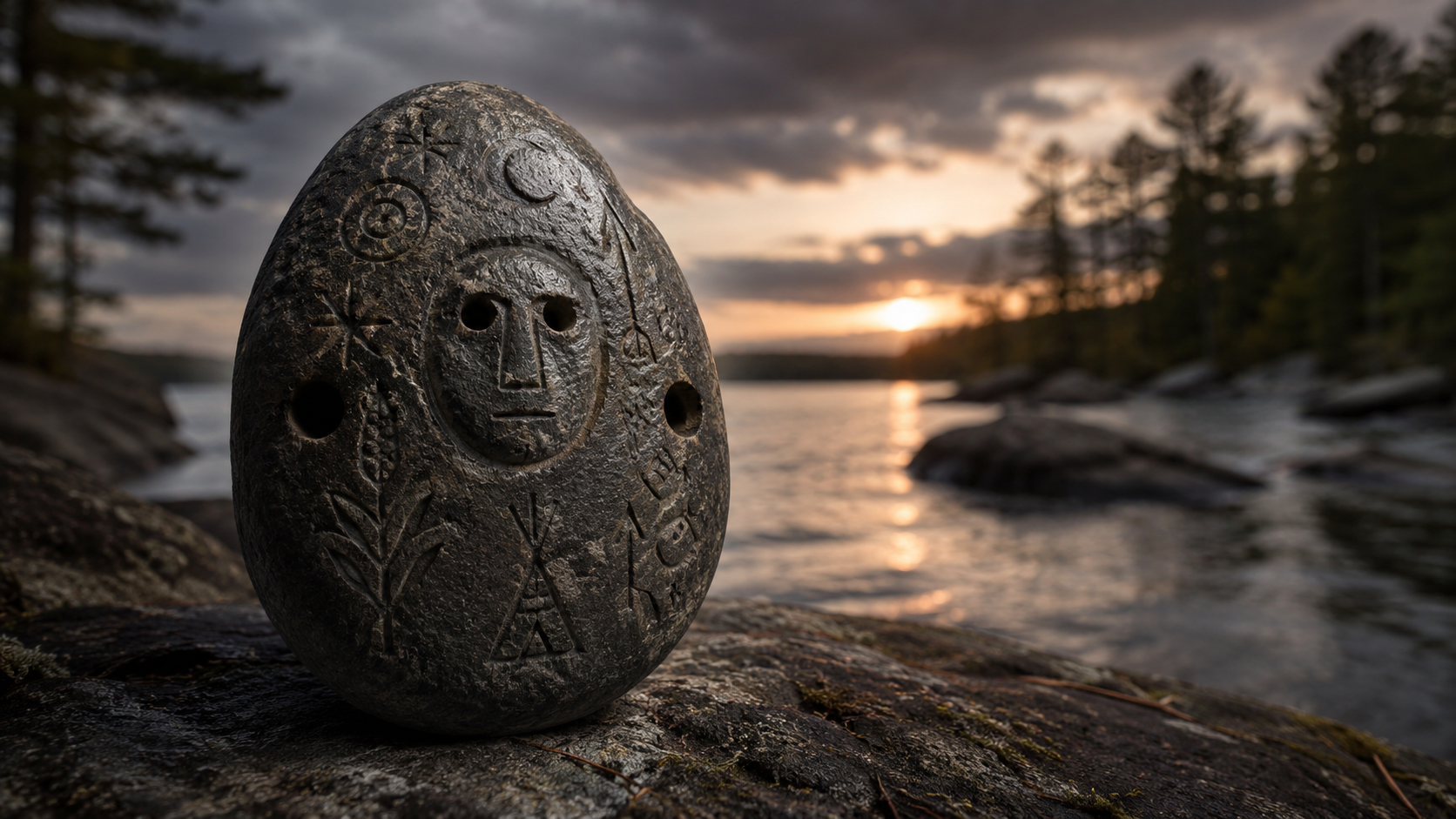
In the summer of 1872, laborers digging near the shores of Lake Winnipesaukee in New Hampshire uncovered a small, polished stone unlike anything anyone had seen before. About the size of an egg, it was covered with strange symbols, a haunting carved face, and two perfectly drilled holes running through its center.
Almost immediately, the questions began.
Who made it? How old was it? And why did it look so unlike any known Native American artifact?
As word spread, the object became known simply as the “Mystery Stone.” It was displayed in a local bank, where curious visitors, scholars, ministers, and amateur historians all offered competing theories. Was it left behind by Vikings? Carved by a lost civilization? A ceremonial object? A memorial? Or something else entirely?
The more people studied it, the stranger it seemed.
Later researchers pointed to clues suggesting it might not be ancient after all. The remarkably smooth finish and precision-drilled holes appeared more consistent with nineteenth-century technology than with prehistoric craftsmanship. If that was true, then another mystery emerged: who created it, and why?

Our latest episode of Antiques Mysteries explores not only the stone itself, but the remarkable moment in American history that allowed it to capture the nation’s imagination. In the decades after the Civil War, Americans longed for evidence that their young country possessed ancient secrets equal to those of Europe. The Winnipesaukee Mystery Stone arrived at exactly the right time.
More than 150 years later, the object remains on display at the New Hampshire Historical Society. Whether it is an authentic relic, an elaborate hoax, or something in between, its greatest power may be that it still refuses to provide a final answer.
Sometimes the mystery is the artifact.
🎧 Listen to the latest episode of Antiques Mysteries and decide for yourself.



Leave a Reply