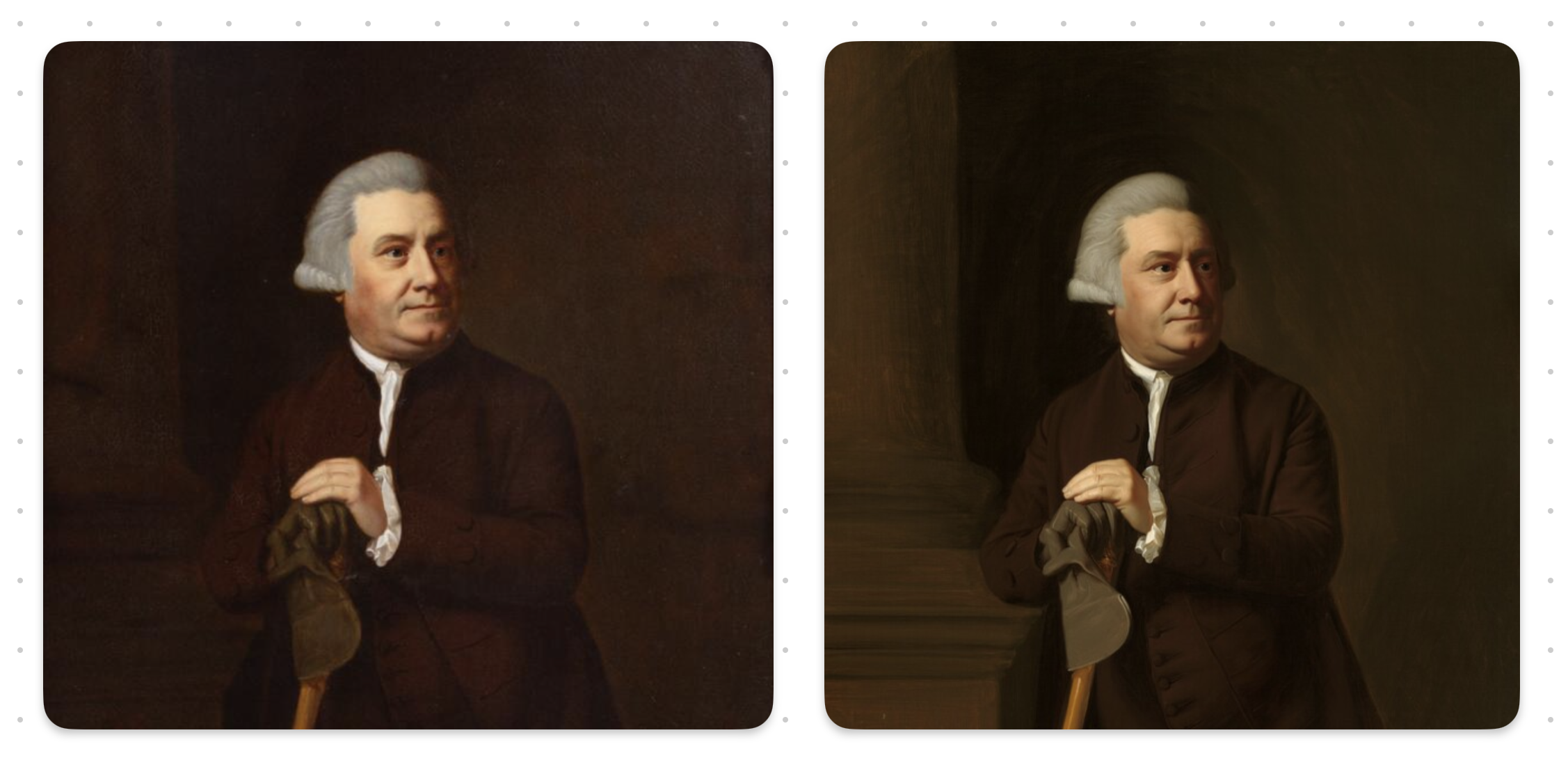
With America approaching its 250th birthday, you’d think there might be an uptick in interest in historical portraits. If there is, it wasn’t reflected in this recent sale.
A large, signed 1853 oil portrait by Bass Otis, depicting Thomas Amory II, after John Singleton Copley, sold for just $550 including buyer’s premium. That’s for a mid-19th-century American portrait by a historically significant artist.
Today, copying another artist might sound like something secondary or derivative. In the early 1800s, it was almost the opposite.
Artists like Bass Otis were trained in a tradition where copying was a legitimate part of the craft. It was how you studied composition and how you learned from the masters.
And Copley was not just any earlier painter, he was the standard. For American portrait artists of Otis’s generation, Copley represented the peak of colonial painting.
Now held at the National Gallery of Art, Copley’s original portrait of Thomas Amory II, painted around the early 1770s, is a classic of colonial American portraiture. Amory appears composed and self-possessed, standing in a restrained interior space, rendered with extraordinary attention to texture and psychological presence.
So when Otis made a copy eighty years after the original, he wasn’t simply reproducing an image. He was engaging directly with the most respected visual language of early American portraiture.
There’s also a practical side to it. By the 1850s, there was real demand for historical portraits, especially among family members who wanted images of important ancestors but didn’t own the originals. A painted copy by a known artist was the closest thing to recovering that lost history.
Thomas Amory II was a wealthy Boston merchant, part of the commercial elite of colonial New England. Families like his cared deeply about legacy, lineage, and visual memory. Portraits weren’t decoration, they were identity.
The original Copley painting captured that identity at its peak. But copies like Otis’s allowed that image to circulate across generations, branches of a family, or even historical societies.
What makes this particular copy especially interesting is that when Otis painted it in 1853, Copley’s original portrait was still in private hands. In fact, the painting remained with descendants of the Amory family for more than two centuries and did not enter a museum collection, the Corcoran, until 1989.
Otis may have had direct access to the original portrait through the family or its descendants rather than working from an engraving or another reproduction. Whether commissioned by the Amory family or by someone connected to them, the copy suggests a continuing desire to preserve and share an image that had become part of the family’s historical identity.
In a pre-photography world, that mattered. A copy wasn’t a downgrade, it was access.
Even today, the appeal isn’t really about rarity. It’s about connection: to Copley, to colonial Boston, and to the idea of preserving a face from early American history.
That connection is particularly interesting as the United States marks its 250th anniversary. Americans have periodically looked back to the colonial era to rediscover their national story, and those moments have often influenced what people collect. The most obvious example came during the Bicentennial in 1976, when interest in Americana surged. Colonial furniture, folk art, historical portraits, and Revolutionary-era objects were actively sought by collectors and museums alike. This follows through and beyond the accession date of the Copley portrait in 1989.
Many categories of Americana have never fully recovered those inflation-adjusted highs. Today portraits of long-forgotten merchants and civic leaders appeal to a smaller audience.
Still, Bass Otis himself is one of those figures who should probably be better known than he is.
Born in 1784, he became a major portrait painter in Philadelphia and worked in a period when American art was still defining itself. He’s also credited with producing what is often described as the first American lithograph in 1819.
Yet Otis sits between eras. He comes after the founding generation of American portrait painting, but before the modern art world that canonized a few key names. Artists like him are historically important, but market recognition hasn’t kept pace with that importance.
That gap shows up clearly in prices like this one, which actually outperforms many recent records for the artist.

To a general audience, this painting may look like several layers removed from significance: a copy of a portrait, by a second-tier artist, depicting a man few people remember. To an art historian, it’s something more interesting: a physical record of how one generation of Americans looked back at its colonial past, preserving an eighteenth-century image for nineteenth-century descendants and, ultimately, for us.
In that sense, the painting tells two stories at once. It preserves the image of a colonial merchant painted by Copley in the eighteenth century, and it reveals how nineteenth-century Americans chose to remember that world.
Today, the painting serves as a reminder that historical importance and market value are not always the same thing. A Bass Otis copy of a Copley portrait may not excite today’s collectors the way it did earlier generations, but it still embodies two centuries of Americans looking back at their own history. For $550, someone didn’t just buy a portrait. They bought a piece of that conversation.



Leave a Reply