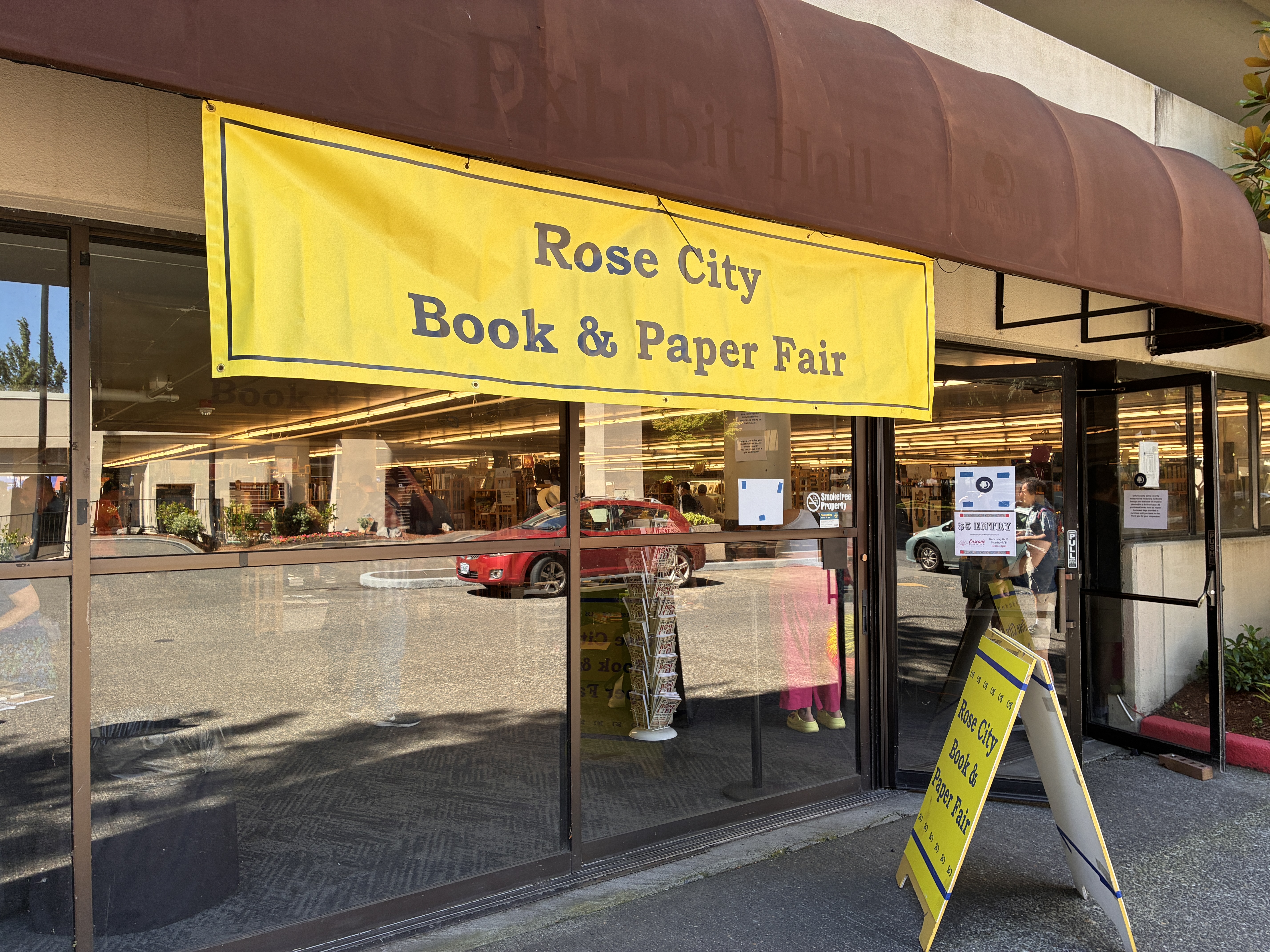
Portland is all about books.
Internationally known Powell’s Books is just the surface. I’ve been to most of the bookstores, but haven’t been to any book events. This was the weekend to change that.
Shop window posters around town announced the 20th Annual Rose City Book & Paper Fair, presented by the Cascade Booksellers Association, but I didn’t seriously consider going until my husband said, “It’s this weekend.” I searched to find the cost, oddly $7.18 (which was the $5 admission plus an Eventbrite fee). Honestly, anything under $10 triggers an “okay, that’s fine.”
Stopping by Belmont Books on Friday, we scored a pair of comps. The universe provides!
We arrived just after the 10 a.m. opening, and the exhibit hall was reasonably full with patrons. It was curious to me that we veered to the right after entering. A New York Times article last week chronicled studies that have found humans to most often walk to the left.
Anyway, it was apparent this event was not just about books. This rightward path brought us to booth Z4, Librariana of Portland, Oregon. Dealer Jason Nairn had a nice variety of books as well as Victorian-era book stands made in London and even several paintings by Portland artist Eliza Barchus. We would eventually bring home a pair of heavy glass bookends made by Blenko in West Virginia.
Next, Michael Fairley and Fairlook Antiques of Seattle brought an impressive array of postcards, photographs, travel items, and more. The photographs were all in binders organized by subject. Looking through an Oregon binder, I noticed an attractive photo taken from the observation platform of a train car showing members of the Multnomah Athletic Club.
A nearby dealer focused on Native American peoples, including the Shoshone, Nez Perce, and Sioux. Most of these books were published in the middle or latter part of the twentieth century. Although they had moved beyond some of the overt white exceptionalism found in earlier publications, many still retained an air of romanticism and mysticism. Taken together, they offer an illuminating study of how Native American peoples have been portrayed—and often interpreted through non-Native perspectives—across different periods of American publishing.
At another booth, I noticed an interesting-looking cover, and it turned out to be The Listing Attic by Edward Gorey. Reading the limericks online when I got home made me glad I didn’t buy it, though.

There were also typewriters, book bags, comic books, some vinyl records, and other things that appeal to a growing number of people weary of the digital world and finding comfort in the tactile.
Historical travel books—especially those about the West Coast and the Pacific Northwest—along with comic books and novels, were all handsomely represented at the fair, each seeming to attract its own distinct group of readers.
Being in Portland, it was no surprise to see many books by Ursula K. Le Guin, including one accompanied by a cassette tape—hello, early audiobook—prepared by her husband, Charles Le Guin, a professor at Portland State University. And, of course, Frank Herbert’s Dune series was well represented.
Although I am not much of a science-fiction reader, I was surprised to learn that The Left Hand of Darkness—the only Le Guin novel I have read—has been challenged or banned in many places. Apparently, some communities have had difficulty appreciating the originality and humor of a line such as, “The king is pregnant.”
The book fair has something for everyone. The sections marked $10 and $20 are always popular, but at the other end of the spectrum was a book priced at $55,000, offered by Swan’s Fine Books of Walnut Creek, California: a first edition signed by F. Scott Fitzgerald.
This was our second time at a book show, and so there wasn’t anything particular I was looking for. And I understand why dealers ask the question, “What can I help you find?” It’s just that I don’t know; I just want to see what this is all about. If you are looking for something specific, the website has a form you can fill out to let dealers know before the show.
I did note from several interactions that this seems to be a well-run show. The promoters had takeaway bookmarks printed for each dealer, had people who could booth-sit, and even brought the dealers lunch.
We ended up buying a 1970 English-language edition of Gabriel García Márquez’s One Hundred Years of Solitude. I am a sucker for a beautiful cover, and this one immediately caught my eye. More broadly, a book fair of this scale offered a quick education in the nuances of rarity, condition, and the value of an author’s signature.
Another dealer had an English-language first edition, also published in 1970. Apart from the words “First Edition” on the copyright page, the publisher, format, paper, and even the cover appeared identical to the copy we were considering.
A first edition is certainly collectible, but books are meant to be read first. Handling a first edition worth hundreds of dollars would make me feel like a child sent outside in freshly laundered clothes—too conscious of keeping everything pristine to enjoy myself. So we bought our copy from Belmont Books for a fraction of the price, and I suspect we will enjoy it much more.



Leave a Reply