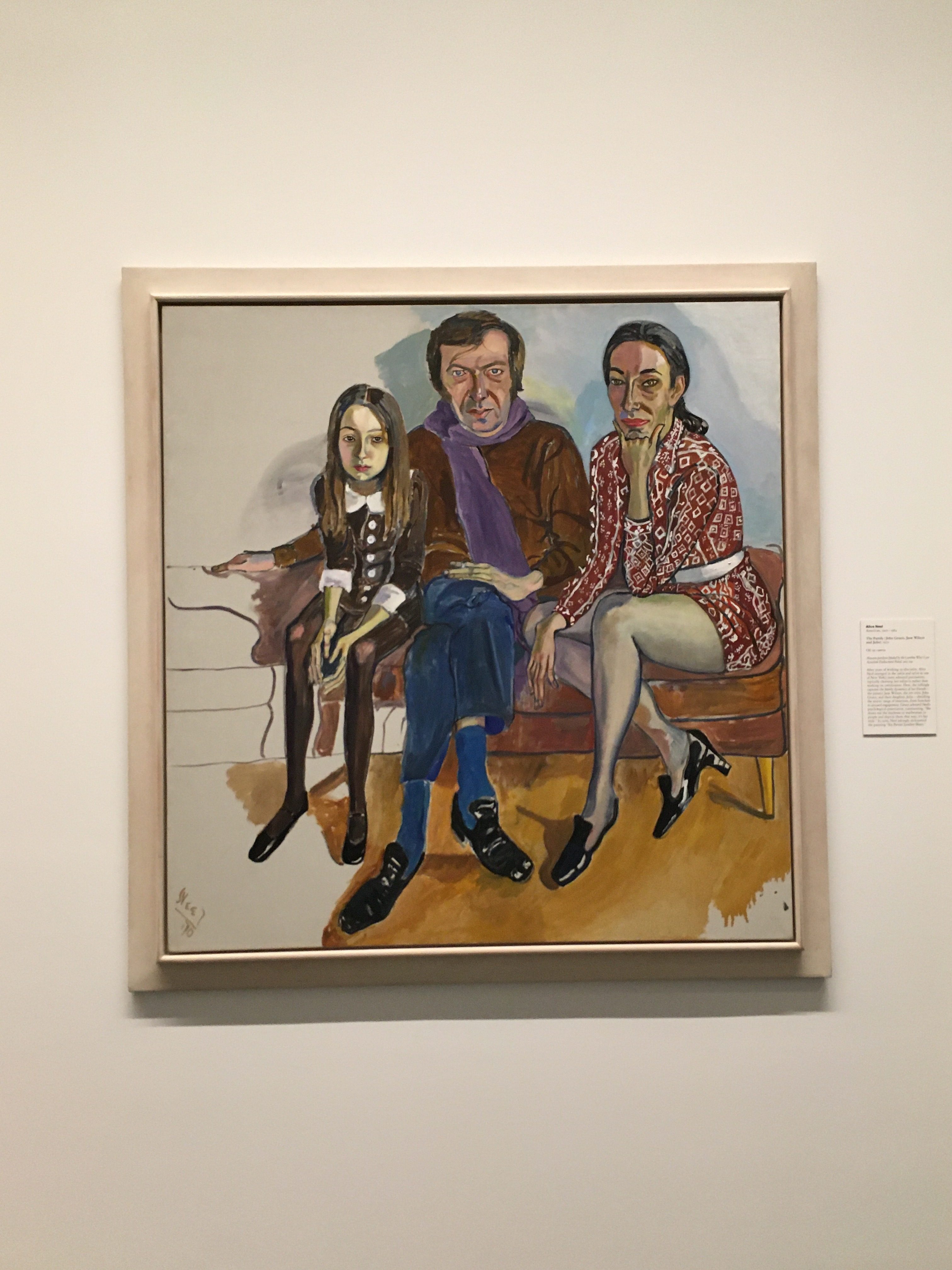
I know at one point, I saw at least a room full of Alice Neel paintings, but I can’t remember exactly where. And I can’t seem to line up my memory with any of the Alice Neel shows over the last 20 or so years. The closest is the show at the Houston Museum of Fine Arts March to June 2010, but it looks like the first time I set foot in Houston was later that year.
And it’s often the case that I don’t always appreciate what I am looking at while I am seeing it. It takes some living, learning, and looking back. Such is the case for Neel, whose animated portraits were out of sync with the art movements of her time.
Continuing with my intention to read mostly art books for four years beginning in 2025, Neel entered my radar after seeing a copy of one of the books about her in the $1 bin at Belmont Books in Portland. As fate would have it, I didn’t have $1 and didn’t want to charge that small amount, so I passed it up. After returning later to look for it or another book, I ended up ordering the 2010 book Alice Neel, The Art of Not Sitting Pretty by Phoebe Hoban.
Through reading this engaging volume, Alice Neel, the complicated person behind the strange portraits, came to life.
Widely known as a communist and a feminist in addition to a great artist, the book chronicles her own struggles as a woman and a mother and makes her failings in marriage and parenting apparent. To say that she put her art first would not be entirely accurate, as it seems painting may have been the only thing that really mattered. Alice Neel was a person who had to paint.
The book also puts Alice Neel into context with the artists she interacted with, including fellow figurative painter Philip Pearlstein and Chuck Close, whom she told point-blank that she didn’t like his work. After hearing Close was a fan of hers, however, she committed to a closer look.
After finding success late in life, Alice, it seems, felt vindicatedfor committing her life to painting rather than motherhood. As the encounter with Chuck Close reveals, she also had a vivid, engaging personality that contrasts with her bouts of depression. Although she was natural in front of a camera on the Late Show with Johnny Carson or giving a two-hour slide lecture at a museum, Alice battled her demons. One published interview goes as follows:
How would you describe yourself?
I am a morbid person.
Do you ever participate in unrequited love?
No, I ruined more men’s illusions than anyone living.
Have you ever been fascinated with death?
All my life I have wanted to commit suicide and I never look out a window without wanting to jump.
What were you thinking moments before you attempted suicide in 1930?
I heard voices. I thought I heard my parents talking. I was at the point of a nervous breakdown. I thought I had gone mad.
What is the most reckless thing you do?
My paintings.
Perhaps most interesting is how the book shows Neel’s work as a continuation of an American tradition. Like Robert Henri (and Thomas Eakins before him), she captures the essence of the human sitting on the chair in front of her.
It took me far too long to come to better appreciate Alice Neel and her work.
I look forward to reading this author’s books on Lucian Freud and Jean-Michel Basquiat.



Leave a Reply