It is a cold, clear wintry day, January 23, 1917 in New York’s Greenwich Village, and the city is in the middle of quietly changing its own mind.
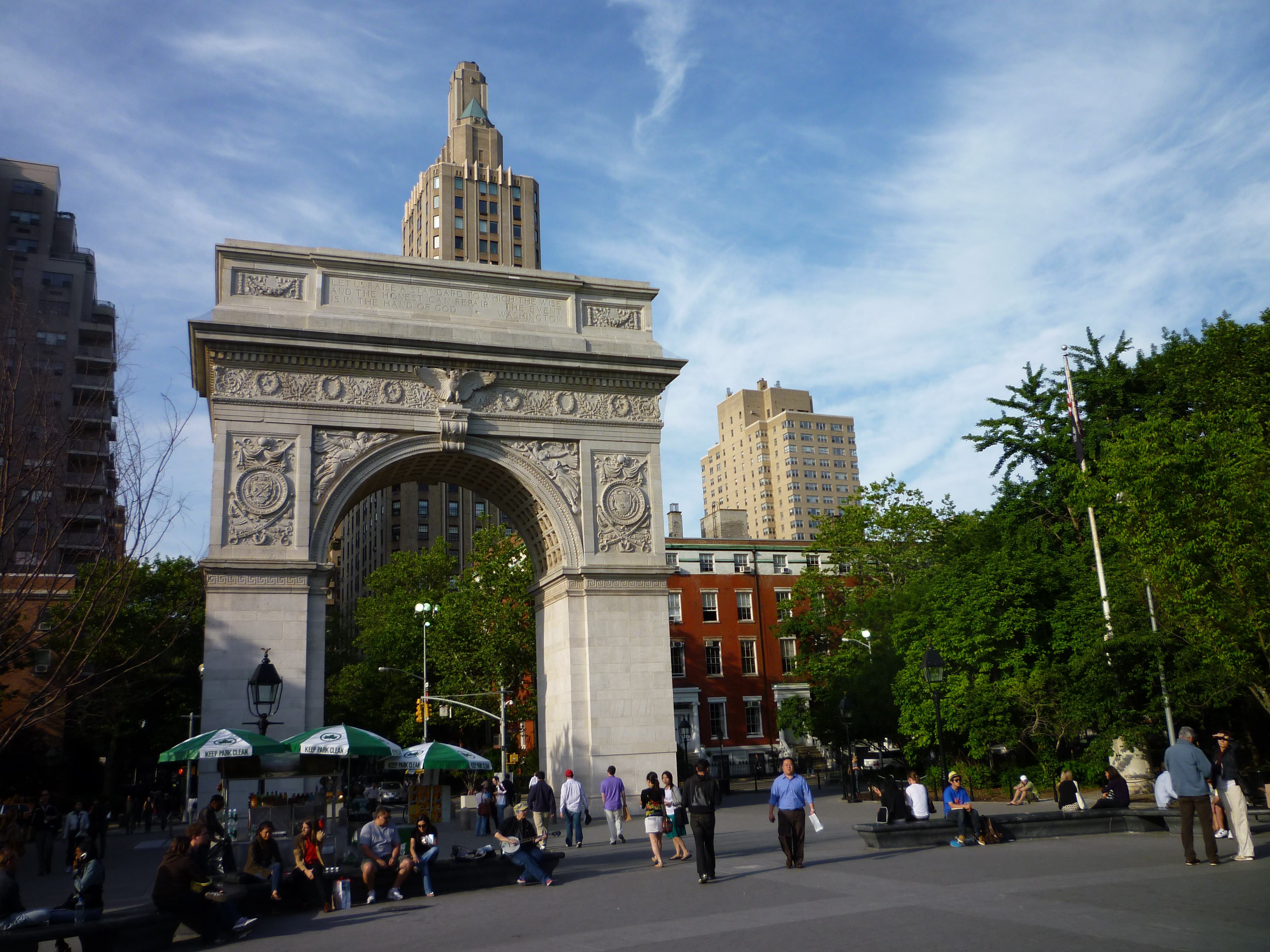
Washington Square Arch stands at the north end of the park like a piece of classical theater dropped into Manhattan by mistake. It is modeled on Roman triumphal arches, meant to celebrate George Washington and national unity. But by the early twentieth century, it has become something else entirely, less a monument to authority than a gathering point for a neighborhood experimenting with new ways of living, making art, and occupying public space.
To understand why a small group of artists and actors ended up on the roof of the Washington Arch that night, you have to understand a bit more about Washington Square.
For decades, the park was not an enclosed refuge. Fifth Avenue cut straight through it. Carriages once rolled under the Arch as if it were just another city gate. Later, early automobiles did the same. The park was not an enclosed refuge.

But change is underway. In 1916, the city closed that stretch of Fifth Avenue to through traffic. The roadway that once cut the park in two is being given back to pedestrians, students, artists, children, and the social life of the Village. The park is becoming a room instead of a corridor.
By the 1910s and 1920s, “living in the Village” was a statement. The neighborhood represented artistic freedom, sexual openness, political radicalism, and rejection of conventional middle-class life.
Out of Philadelphia and into the Village comes John Sloan and many others. Trained as an illustrator, Sloan learned to think in terms of newspapers, deadlines, and the compressed drama of urban life. When he arrives in New York, he starts painting and etching scenes of tenements, laundries, bars, and street corners. Not the monumental city of skylines and civic pride, but the city at eye level, where people are working, arguing, joking and surviving.
He becomes associated with what will later be called the Ashcan School, though he never fully embraced the label. What he cared about was the idea that ordinary life deserved to be seen without decoration. That a barroom could be as worthy a subject as a palace, or the Washington Arch, if you looked at it honestly enough.
One of Sloan’s students, Gertrude Drick, belonged to that overlapping world of painters, poets, actors, and provocateurs that defined the Village at the time.
Drick is an actor and theater figure involved in the experimental performance circles of the Village. These are not yet the polished avant-garde institutions that will come later. They are loose, often improvised productions, half rehearsal and half argument, where performance is inseparable from social critique. For people like Drick, theater is a way of stepping into public life and rearranging its expectations.
Sloan and Drick were joined by renowned French artist Marcel Duchamp and actors Charles Frederick Ellis, Alan Russell Mann and Betty Turner. So when this small group gathers, it is not an accident or a party in the ordinary sense. It is closer to a collective gesture.
They enter the Washington Square Arch through an unlocked interior door. Inside, there is a narrow spiral staircase leading upward. It is the kind of architectural feature most people never think about, a hidden infrastructure inside a monument that is usually seen only from the outside.
With them are blankets, lanterns, food, and the practical supplies of people who intend to stay awhile. What they are doing is part prank, part performance, part symbolic occupation.
In retrospect, the evening feels startlingly modern. Decades before Allan Kaprow would coin the term “Happening” in the late 1950s, Sloan, Drick, and the others are already blurring the line between art and life, performance and public space. There is no audience in the conventional sense. The gathering itself is the artwork. The city becomes stage, backdrop, and participant all at once.
When they reach the top, the city opens around them in every direction. Manhattan at night in 1917 is not yet the dense vertical blaze it will become later, but it is already active, layered, restless. From that height, the streets look like lines of movement and light.
That tension matters. They are literally above a city that is being redesigned beneath them.
During the night, someone frames it as a kind of declaration, a symbolic secession from conventional America. A way of saying that the rules governing art and life do not have to be the same rules that govern official society.
Sloan watches, and later translates the scene into image. For him, the meaning may differ from that of Drick.
In Sloan’s etching, the figures are small against the mass of stone, clustered on the roof of the arch while the city continues below. The effect is not heroic in the usual sense. The city itself becomes both stage and audience.
By morning, it is over. They come down the stairs. The city resumes its ordinary motion, now fully in the new configuration where traffic no longer cuts through the park.
Nothing visible changes because of their night on the roof (although the stairs would soon be locked). And yet the story persists.
It persists because it captures a moment when the physical city and the imaginative city briefly overlapped, when a monument could be climbed not to escape the world, but to reinterpret it, and when the space under the arch, once filled with wheels and engines, had just recently been returned to feet, conversation, and experiment.
Sloan would go on painting the city for decades, holding to his belief that ordinary life carried its own dignity, even as modernism and abstraction pulled the center of gravity in American art elsewhere. He remained, in a sense, a witness to the street rather than a theorist of it, increasingly out of step with the movements that followed but steady in his attention to lived urban detail.
Duchamp, by contrast, would leave behind painting almost entirely, transforming his reputation through conceptual works that quietly undermined the authority of art itself and redrew the boundaries of what art could be.
Drick fades more softly from the historical record, her name surfacing mainly in connection with the Village’s theatrical and bohemian circles, one of many figures who helped generate an atmosphere rather than a canon.
Taken together, their later lives trace a familiar pattern: from a shared moment of improvisation above Washington Square, they disperse into three different versions of modern art, one rooted in observation, one in disruption, and one in the fleeting, collaborative energy of performance.



Leave a Reply