Santa Fe Art Auction has just concluded its two-day sale, Art of the West. The title itself is telling—it signals a broader and more nuanced scope than the often-dismissed label of “Western art.” As one fine art director at a major auction house once quipped, Western art is “for people who don’t like art,” or perhaps, like the West more than art. Art of the West, however, stretches well beyond that stereotype, especially when it embraces the artistic legacy of the American Southwest—home to both the Taos School and modernists such as Georgia O’Keeffe and Raymond Jonson.
The sale featured a strong roster of staple names, from celebrated printmakers Gene Kloss, Gustave Baumann, and Doel Reed to historical painters like Joseph Henry Sharp, Walter Ufer, and Leon Gaspard.
It was, however, in the contemporary category that a few surprises emerged. Jerry Jordan’s The Town of Eagle Nest sparked a lively bidding war—no doubt welcome news for Manitou Galleries, which continues to represent the artist. An early pastel by Ted Larsen, Looking Under Aspens, also exceeded expectations. Larsen, who describes himself as “a painter without paint,” demonstrates here the same aesthetic sensibility found in his later work: a delicate surface built from thin pastel strokes that both obscure and reveal the wood beneath.
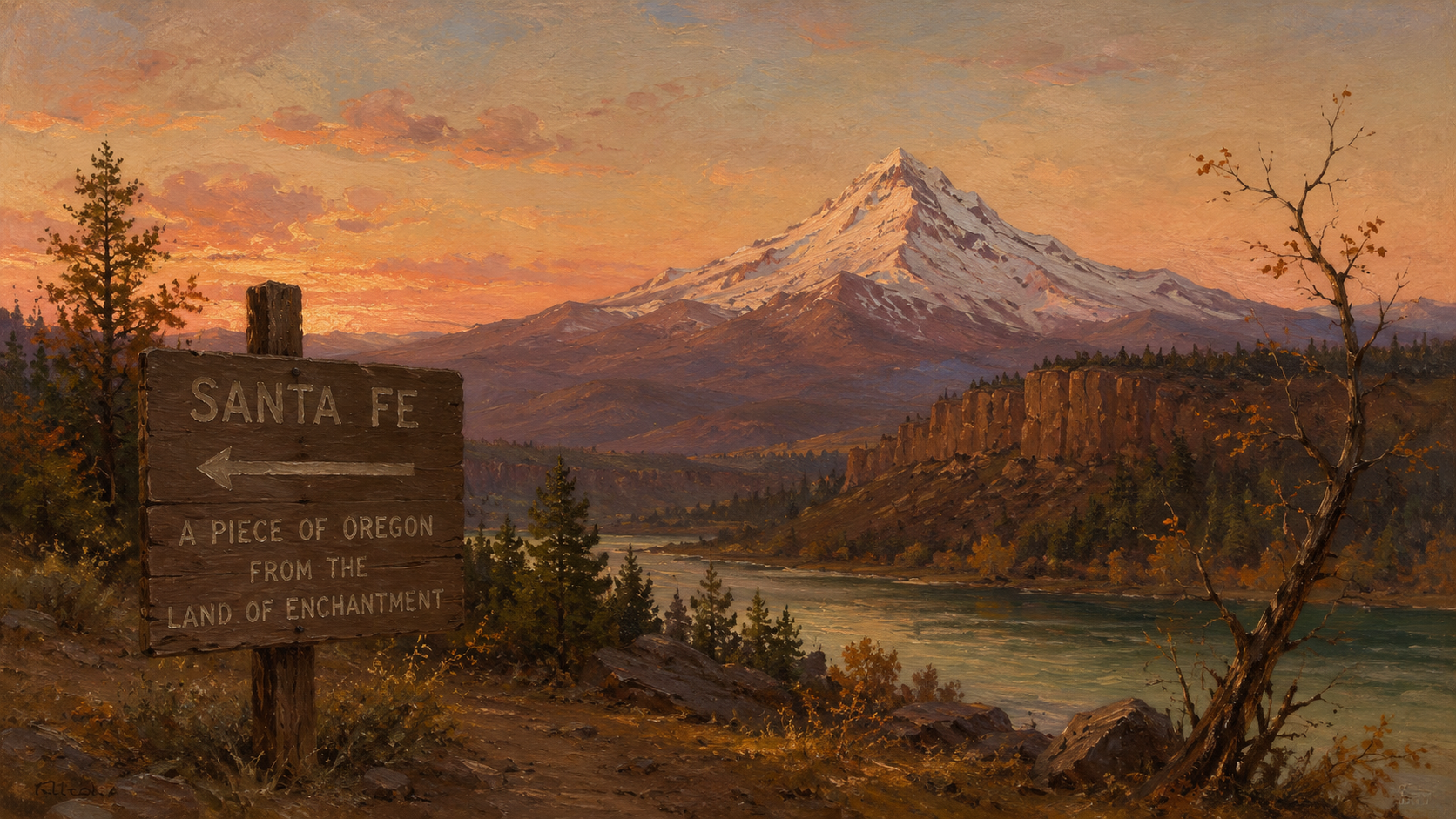
Given that the American West is bounded by the Pacific, it is perhaps unsurprising that early Pacific Northwest landscapes appeared in the sale. Eliza Barchus’ large-scale view of Mount Hood presents a dramatic autumnal sky, where texture across snow, clouds, and trees, heavy-handed if applied to small scale, is fittingly effective in this impressive large painting (22 by 36 inches). The work realized $3,700 plus premium.

Two additional lots by James Everett Stuart offered his signature sunset glow—one depicting Mount Adams, the other Mount Hood. The Mount Hood example, in particular, stands out as a compelling object. Modest in scale and painted on tin, it is presented within an elaborate Rococo-style frame—an object as much of Victorian taste as of frontier imagery. Despite a certain naïveté in execution, the painting possesses a striking sense of place. The emerald green of the Columbia River contrasts with the pink-tinged, snow-capped peak, while the fading light catches a rugged bluff of stacked basalt. In the foreground, a barren, skeletal tree holds the last traces of sunset, subtly reinforcing the isolation of the landscape.
Despite a certain naïveté in Stuart’s style, the painting is rich in atmosphere. The emerald green of the Columbia River contrasts vividly with the pink-tinged, snow-capped peak. The fading light catches a rugged bluff of stacked basalt, while the last trace of sunset clings to a barren, skeletal tree in the foreground. Together, these elements evoke a sense of remoteness—an Oregon landscape untouched at the turn of the 20th century. Both Stuart paintings sold for $3,000 each, plus auction premium.
Santa Fe, New Mexico, lies some 1,500 miles from the emerald greens of the Pacific Northwest. Yet it is no coincidence to find Oregon landscapes in a New Mexico auction. One stands as a gateway to the American West; the other, its distant terminus at the end of the wagon trail. Different in climate and vegetation, both regions have long inspired artists with their dramatic scenery. In that shared appeal, they reveal a kindred sensibility—one that continues to resonate with collectors and audiences alike.



Leave a Reply