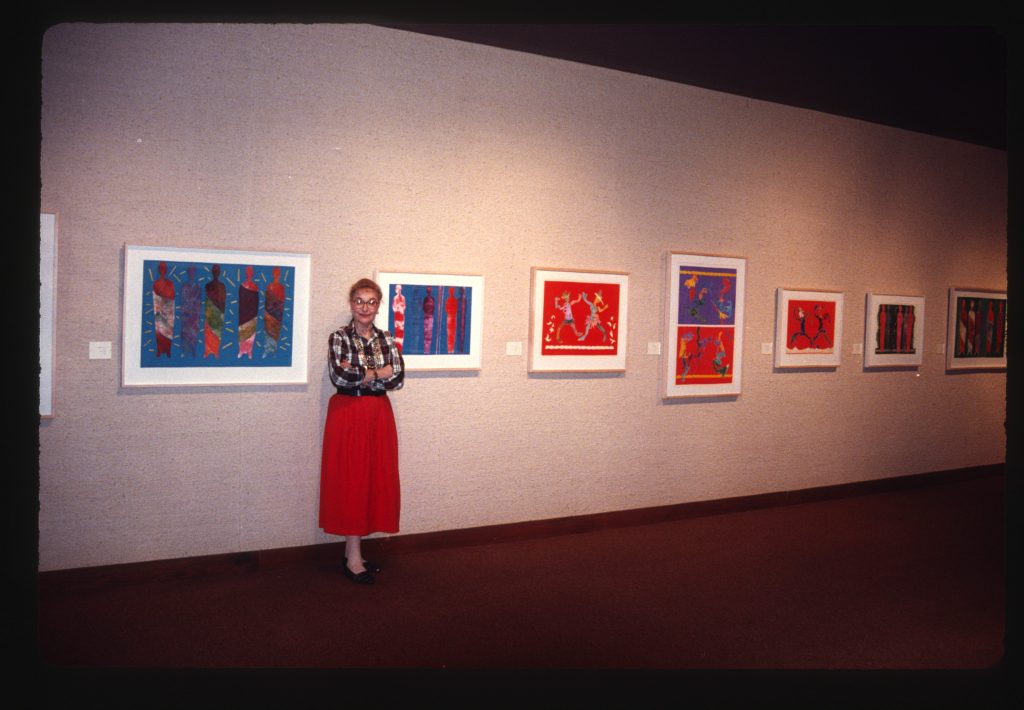
In 1989, artist and scholar Maryanne Meltzer submitted a master’s thesis to the University of Texas at Dallas with a title that reads like a diagnosis: Artists Depict Alienation: The Contemporary Social Disease. For Meltzer, alienation wasn’t an abstract idea—it was a lived condition, “the spiritual malaise of modern Western society,” marked by “loneliness, estrangement, depression, and a feeling of impotency in dealing with the complex problems of modern life.”

The thesis traces this malaise back to seismic historical changes. “The widespread contemporary aspects of alienation,” she wrote, “seem to stem primarily from the major changes in life patterns which were the result of the Industrial Revolution.” Karl Marx had described alienation in 1844 as the separation of people “from the product of [their] labour… from other men,” while Erich Fromm saw its roots in the breakdown of medieval community life and the rise of individualism under capitalism. For Meltzer, these forces left people “abandoned, forlorn, and vulnerable,” even in an age of technological progress.
Artists, she argued, have long reflected and resisted such social conditions. Historically, they moved from serving as shamans and artisans for rulers to becoming independent commentators on “the seamier aspects of society.” In the modern era, many have turned their attention to alienation. Meltzer zeroed in on two American painters who, despite stylistic differences, shared an uncanny ability to depict isolation: Edward Hopper and George Tooker.

Hopper, “the painter of loneliness,” often placed solitary figures in anonymous urban interiors—hotel rooms, diners, offices—bathed in uncompromising light. In Nighthawks (1942), she noted, “a group of strangers [is] assembled for a few moments in an all-night restaurant… isolated and alienated from each other, communicating by neither touch nor glance.” His Room in Brooklyn (1932) shows a lone woman gazing passively out a window, separated from the viewer by a shadow “barrier,” while Early Sunday Morning (1930) strips a city street of life, leaving only “forlorn solitude” in the cool morning light.
If Hopper’s world is lonely, Tooker’s is claustrophobic. Using egg tempera and meticulous planning, he built allegorical spaces of bureaucratic or technological entrapment. In Landscape with Figures (1966), Meltzer describes “a geometric series of grids” containing “almost identical male and female faces” with “dazed, numbed expression[s]… one of humankind’s most persistent nightmares.” Government Bureau (1956) shows faceless petitioners and oversized clerk eyes staring “cold[ly]… ignoring the waiting people.” For The Waiting Room (1959), Tooker himself called it “a kind of purgatory—people just waiting… not being one’s self… waiting for something that might be better—which never comes.”
“A kind of purgatory—people just waiting… not being one’s self… waiting for something that might be better—which never comes.” — George Tooker, on The Waiting Room

Meltzer didn’t just analyze other artists—she put her own work on the examination table. In Eleven Brides (1985), eleven emaciated women are “seemingly entombed” in womb-like membranes, their gestures passive and expressions dull. And Who Speaks? (1987) presents three blind-eyed women with dangling hands: “It is our own responsibility to speak, to act, to influence the fate of humanity,” she wrote. Her Walking Men prints (1987–89) feature blank, eyeless men moving mechanically toward unknown destinations, a “life’s endless treadmill” stripped of individuality.

Across all these examples, Meltzer identified a toolkit of visual “devices” that communicate alienation: the selection of subject matter that disconnects viewer and figure, body language that signals passivity, color choices that jar or chill, spatial relationships that crowd or isolate, distortion that dehumanizes, light that exposes without warmth, repetition that erases individuality, and masks that hide or falsify identity. These, she argued, “immediately establish a loss of individual identity” and turn human subjects into emblems of a shared condition.
For Meltzer, such art doesn’t just decorate—it diagnoses. Quoting philosopher Herbert Marcuse, she reminded readers that “the truth of art lies in this: that the world really is as it appears in the work of art.” In the worlds of Hopper, Tooker, and her own canvases, the view is clear: ours is a society crowded yet disconnected, illuminated yet cold, in which too many live, as she put it, “alienated—from each other and from life itself.”





Leave a comment