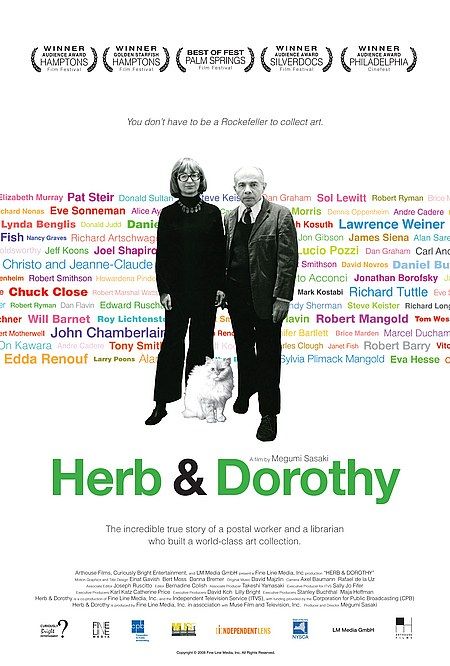

The documentary “Herb & Dororthy” is not only a story about how to amass a world-class collection with a minimal income, but also a story of an exceptional couple whose passion for art and obsessiveness of collecting outshine others with deeper pockets and bigger stature.
Although the income from jobs as a postal clerk (Herb) and a librarian (Dorothy) maybe small, the stable jobs at least guarantee their income was not fluctuating with Wall Street. The jobs also necessitated they could pursue their passion in the afterwork hours. Moreover, there are too many collectors who are swayed by the market trends and buy artworks as if they are stocks. It seldom works because as Sister Wendy says, contemporary works need more time to be digested and understood. The greatest collectors buy ahead of the market with their eyes and hearts. By the time when certain artists or schools claim media and market appreciation, little room is left for opportunity seekers.
The Vogel’s bought what they like and what they could afford to fit in their budget and living space. I expected the movie would shed light on how Vogel’s judge the quality of or interpret the meaning of minimalism and conceptual art. But too few clues can be found in this film. On one occasion, you can hear Herb — the driving force of the collection (based on Dorothy’s comments)– remarking on a photo of “Keith” by Chuck Close as a process of the process, which would be used to choose crop marks for the larger work. Another case appears when Herb thought the small sculpture was placed wrongly and exclaimed that it is hard to make a small sculpture that feel like a big one. However, most of time the only diologue heard is to the tume of general comments like “they are beautiful” or “they are great.”
This is different from some adult museum-goers who feel disoriented and stupid in the contemporary galleries and walk away from the works before the resonance of the same comments die out in the gallery. The Vogel’s look. They look long enough as if there is a universe inside the artworks. And they look more, sometimes directly from the artists. They look not only completed works, but also processes and sketches. They may not paint, but they want to look at the artworks from the artist’s point of view.
Such understanding can be deeper than what words could purport. Thus whatever words they use to describe their feelings are not that important.
I have not been a fan of abstract art. For most of the modern or contemporary art, I either get it or could not stand it. But what Herb and Dorothy have shown is that the intellectual quality and interpretability is less important than the instinct stimuli and instant aesthetic enjoyment. Abstract artworks, even in the form of pure texts should be approached first as an assembly of lines & patterns, light & shades, colors and movements. In the least subjective manner, such works demand the most subjective, almost primeval comprehension. In short, words fail.
As much as I admire their fortitude in collecting, I disagree the way they pile up and hoard the collection in their one-bedroom apartment. Without National Gallery of Art, they would have probably never figured it out exactly how many pieces of artworks they had. Nor could they have displayed artworks properly. Modern and contemporary artworks need room to breathe, a proper premise they could not follow. In the documentary, I saw piles of folders next to the bed. What if the cat jumps onto the pile or scratches some papers? An art guardian should not only preserve the works, but also pursue to the best way to show their beauty. With more than 4,000 artworks in the one-bedroom apartment, I doubt they could even look at them frequently since they are in the perpetual hunting of the next one.
The final decision to select 50 museums in 50 states to donate their collection is a wise one since National Gallery of Art cannot absorb more than 1,000 artworks from their collection. True, NGA never deaccessions their works, but what is the purpose if those arts cannot be shown?
Again, I like to quote Miron True, the former curator of antiquities of the J. Paul Getty Museum. “But if we don’t show those things, and we don’t interpret them and we don’t use them to educate people, what are they surrounded by? Plastic and bad design and things that have no aesthetic quality at all.”
From Youtube: Herb and Dorothy: Philadelphia Film Festival Q&A
Megumi Sasaki director of the documentary film Herb and Dorothy and Ann Webb executive director of the Canadian Art Foundation discussed what inspired Megumi s interest in the story of the Vogels.
http://vimeo.com/moogaloop.swf?clip_id=3207759&server=vimeo.com&show_title=1&show_byline=1&show_portrait=0&color=&fullscreen=1
Reel Artists Film Festival: Megumi Sasaki, director of the documentary film Herb and Dorothy from Canadian Art on Vimeo.



Leave a Reply to TheLittleArtistCancel reply