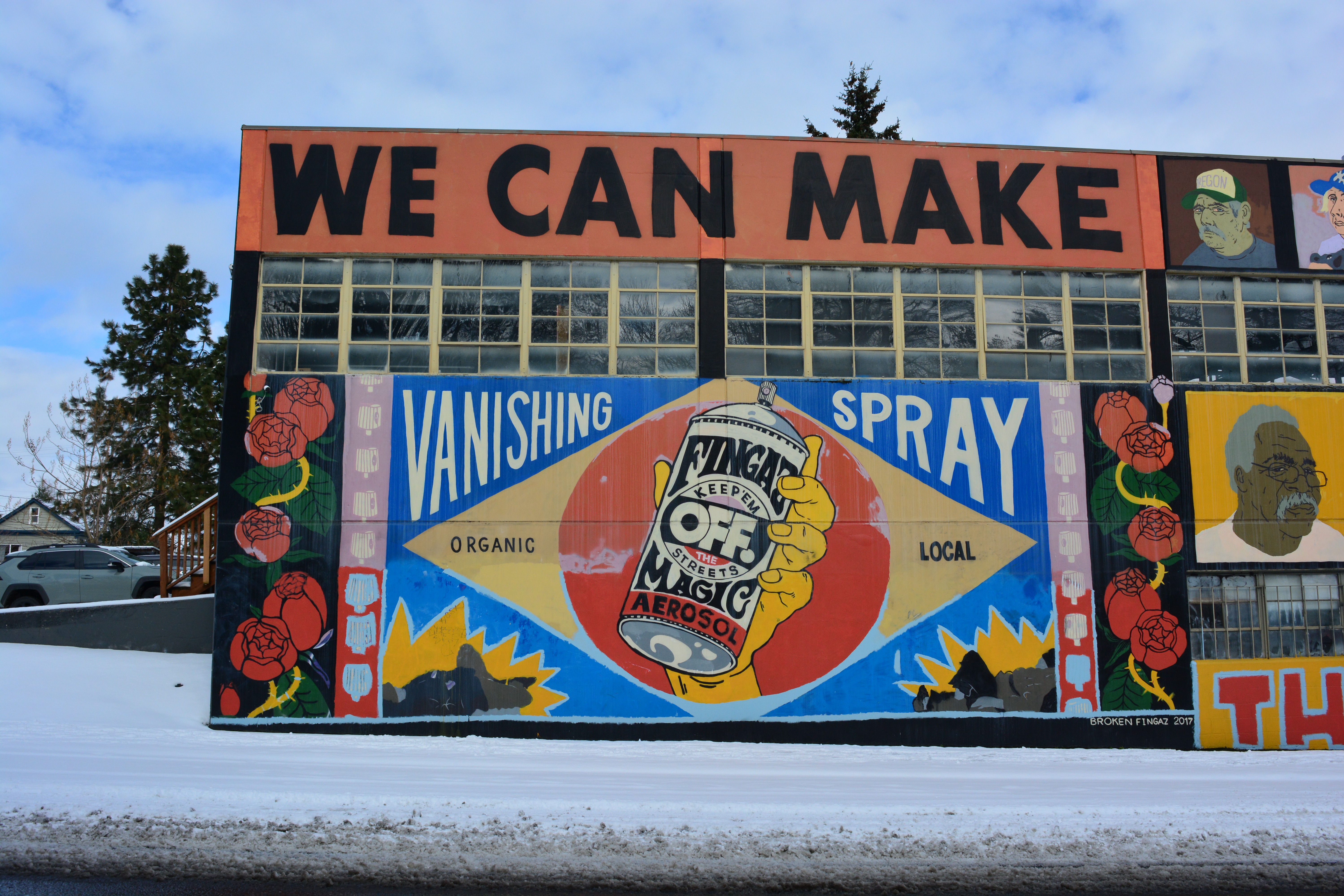
Is Portland a good place to make it as an artist?
I just picked up Get the Picture by Bianca Bosker. Almost immediately it reinforced the perception, and most certainly the reality, that New York is still the center of the art world.
Lucky enough to have lived in New York for several years, not enough of that time was spent visiting art galleries. The secondary market was more interesting then, in part because it offered a broader range of obtainability. Dallas was also home for quite some time and does seem to have a solid art market, though collectors there have a reputation for looking to New York, and if you like older things, France.
Artists in Dallas, at least those of an older generation, all seemed to have opinions about New York. Texas pop master Bob Wade told us about his years there. His cowboy boots, now at a mall in San Antonio, were once profoundly perched on a vacant lot, while an oversized iguana took up residence on a rooftop. The sculptor Mac Whitney explained that in the art world, there’s a bottom and a top. Young artists think there would be a middle, but there really isn’t. The top is in New York.
I asked my friendly chatbot to rank art markets in the U.S. In addition to New York, the top cities were Los Angeles, Miami, Chicago and San Francisco. In terms of state art markets, Texas comes in fourth behind New York, California and Florida. Makes complete sense, as those places would seem to have the most money.
But where do artists become known?
As best as I can tell, somewhere between 35 and 60 percent of artists who break out nationally do so through New York City. Here’s the interesting part, though: it’s not the ultimate gatekeeper it used to be.
A big reason, as much as artists and galleries complain about them, may be art fairs.
We saw this in Texas as the Dallas Art Fair continuously grew in stature, bringing in bigger and better galleries. In fact, on a visit two years ago, we met two people mentioned by Bianca in her book. A gallery no longer has to be in New York to get in front of New York collectors, and an artist represented by a gallery in Dallas, Portland or somewhere else isn’t necessarily confined to that city’s market.
It looks like artists don’t put up with the high cost of New York as much either. According to a study by the Center for an Urban Future, over the last decade New York has lost a chunk of its artist population, including 56 percent leaving the Lower East Side/Chinatown, 18 percent gone from Chelsea and 17 percent from Harlem.
So where did they go?
Upstate, Philly, Baltimore or the Sun Belt. They may not be art centers like New York, but now they have Instagram on their phones.
A Reddit post indicates at least some did something different, heading to creative hubs like Providence, New Orleans and Portland, Oregon. There don’t seem to be solid statistics to back this up, however. If anything, Portland’s creative community may be contracting thanks to a higher-than-average cost of living.
Still, geography doesn’t seem to matter quite as much as it once did.
One thing that has allowed more artists to live outside traditional art centers is Instagram. Artists complain about it, galleries complain about it, and the algorithm certainly isn’t anyone’s idea of an enlightened curator. But artists have been discovered there.
The numbers are striking. One survey found 80 percent of art buyers used the platform to discover artists in 2019, and 75 percent of those used it to make a purchase. An Artsy survey found collectors who had discovered artwork on Instagram bought an average of five works from an artist they discovered there. Moreover, a 2025 Art Basel/UBS survey of high-net-worth collectors found 51 percent had purchased art through Instagram. And it’s not just buyers. Almost 90 percent of galleries surveyed by Hiscox used social media, and there are plenty of examples of galleries finding artists through it.
I’ve even heard that Instagram has helped move art away from abstraction because abstraction isn’t particularly small-screen friendly. I’m not sure there’s evidence to prove that, but it’s an interesting thought.
So if artists don’t necessarily have to live in New York anymore, how do you measure the importance of an art city?
Something called the Arts Vibrancy Index placed Portland at number 34 in 2025. It does, however, rank as one of 22 communities on the list of 100 mentioned at least three times since 2020, indicating sustained cultural vitality since the pandemic era. In terms of states, Oregon is number 10, while Texas languishes at the median of 25.
What about art galleries per capita? It would seem to be a reasonable measure until you realize New York doesn’t make it anywhere near the top of the list. And if you considered Santa Fe and Taos, with their small populations and many galleries, they’d blow nearly every other city away.
During those Dallas years, Santa Fe provided a frequent getaway. A lot of people buy art in Santa Fe, and there is a good bit of relevant, for lack of a better word, art to see. Yet it doesn’t seem like the kind of place you’d go to make it as an artist.
Indeed, we talked to at least one artist who, surrounded by piñon and Christmas chiles, moved back to Dallas after feeling separated from the art scene.
Maybe that’s because we’re really talking about several different things.
There’s where art is made, where it is shown, where it is bought and where reputations are made. For much of the last century, New York managed to be all four. Today those things seem increasingly scattered across the country.
Perhaps another way to think of art capitals is the amount of money spent on art in a place. There aren’t good numbers on this either, but you have New York, Los Angeles and Miami, then places like Santa Fe, San Francisco, Chicago, Palm Beach, Dallas and Houston, Aspen and Scottsdale. One ranking even placed Seattle near the top for art-buying locals. We really do need that art fair.
So what about Portland?
Perhaps it’s third tier, but we know that’s not the whole story. This soon to be our fourth year in the city has been full of art for sure. It’s a creative, and crafty, place, perhaps better known for animation than “fine” art. But who likes categories?
The local institution Art in the Pearl ranks among the top juried art fairs in the country. There also seems to be a penchant for buying local art, something everyone seemed to think there was too little of in Dallas.
One person’s provinciality is someone else’s regional pride.
And maybe provincial isn’t a word that quite fits Portland anyway. “Regional” might be closer. There is a recognizable creative ecosystem here, one that doesn’t seem particularly concerned about whether New York approves of it. Fine art sits alongside craft, ceramics, illustration, printmaking, design and animation. The boundaries are blurry, which may be part of the point.
But maybe Portland doesn’t need to become an art capital. The more interesting question is whether cities like Portland still need art capitals at all. Artists here can make work in Portland, show it at a local gallery, put it in front of thousands of people online, meet galleries and collectors at fairs elsewhere, and build a career that only occasionally passes through New York.
New York is still the top. Mac Whitney was probably right about that. But the routes to the top, or around it, have multiplied.
Wherever you are, gallery season goes all year, but it also starts in September. The Thursday and Friday openings, featuring at least one artist, Lis Pardoe, who actually did move to Portland, will follow quickly with Art in the Pearl.
Whatever the city’s status in the art world, we’re here now, the art is here, and there’s a lot to take in. Let’s get started!



Leave a Reply