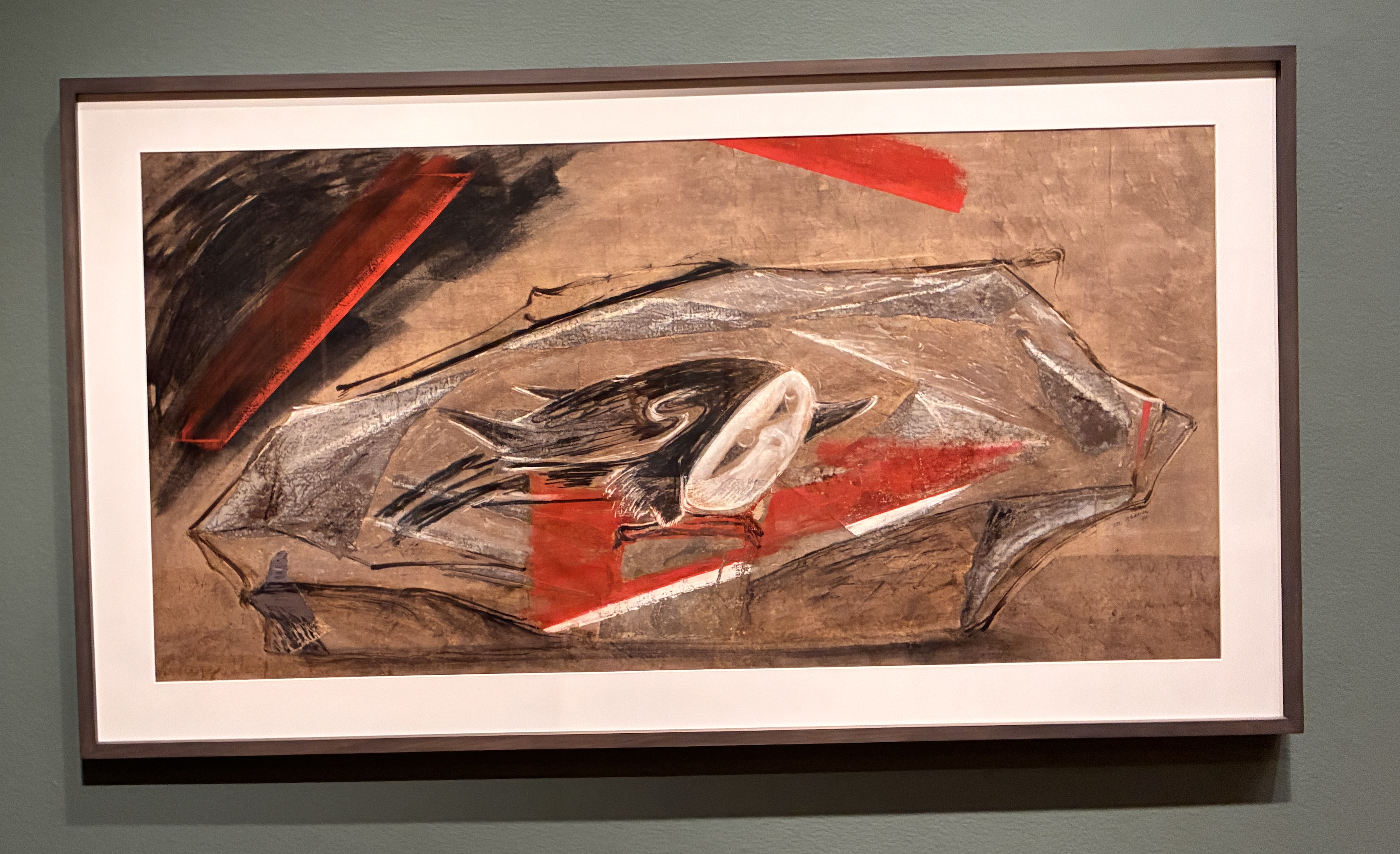
“Mysticism” is a confusing label for a group of 20th-century artists featured in a new exhibition at the Seattle Art Museum. Beyond Mysticism: The Modern Northwest explores a wide range of work created in the Pacific Northwest, revealing how artists drew inspiration from Social Realism, Precisionism, Surrealism, and Abstract Expressionism rather than a single regional style.
As we argued in a previous article, there may never have been a single Northwest “school.” This exhibition reinforces that idea, showing artists whose styles are as varied as their influences.
The idea of a Pacific Northwest School is comparable to the Dallas Nine, whose members shared recognizable artistic threads while maintaining distinct voices. Here, however, the notion of “mysticism” seems to arise primarily from the work of Morris Graves rather than from a consistent regional aesthetic.
The exhibition opens with early twentieth-century urban scenes by Kamekichi Tokita, Kenjiro Nomura, and others. Encountering Arthur Dove’s Power Plant immediately raises a question: what does any of this have to do with mysticism? The answer lies in the exhibition’s title—it moves beyond mysticism rather than attempting to define it.
The stage is set for our continued urban exploration with Reginald Marsh’s Tuesday Night at the Savoy Ballroom. Photographs from the Jazz Age in Seattle then walk us into one of our favorite works in the show, Mark Tobey’s E Pluribus Unum (below), which shows the sea of people at Pike Place Market. Often described as the founder of the Northwest School, Tobey’s influence extended far beyond the region. Ironically, the artists became closely associated with “Northwest mysticism” after a 1953 Life magazine article grouped Tobey with Guy Anderson, Kenneth Callahan, and Morris Graves.

From there we move into landscapes and figurative work depicting the heroic and tragic sides of the logging industry. Callahan’s works (below), Evening at Mist Mountains and Mountain Landscape, hold their own alongside paintings by Alexandre Hogue and a stunning tree study by Georgia O’Keeffe.

Here we also encounter the most mystical of the painters. Through Morris Graves’ Bird Sensing the Essential Insanities (cover), we encounter a bird’s-eye view of the encroachment of humans and the environmental destruction that came from industry. Graves’ works verge on abstraction and present nature less as literal observation than as spiritual presence.

Equally compelling is James Washington Jr.’s Wounded Eagle No. 10, a work that suggests another kind of devastation. Washington considered his sculpture a spiritual practice, making it one of the exhibition’s most direct expressions of mysticism.
Salvador Dalí first visited New York in 1934 and spent much of the 1940s there. It would be surprising if Northwest artists had ignored Surrealism. By then, the movement had influenced not only painting but also literature, film, fashion, advertising, psychology, and politics through its fascination with dreams and the unconscious mind.

Two paintings by Malcolm M. Roberts (above) mesh the surrealism of the mind with the physicality of the regional landscape. View of Aurora Bridge shows a nighttime view of the 1932 structure connecting the neighborhoods of Queen Anne and Fremont in Seattle, along with two strangely illuminated sailboats. The other, The Beach, shows a surreal composition set within a typical Oregon coastal scene. The influence of Giorgio de Chirico, Max Ernst, and Dalí is especially evident in these paintings.
The exhibition concludes with Abstract Expressionism, where Franz Kline’s influence becomes apparent. The large ink strokes are reminiscent of Japanese calligraphy. Hilda Grossman Morris would have perhaps been the perfect artist to look at in relation to the Kline work, but it also provides an interesting setting for painter and collage artist Paul Horiuchi. His work fuses traditional Japanese collage with Abstract Expressionism.

As we follow these artists and their work through this exhibition, it’s worth remembering that while a variety of artistic movements and styles shaped the era, each artist drew inspiration from different sources and worked in a distinctly individual way. Their influences came from Europe, New York, Asia, and their own lived experiences as much as from the Pacific Northwest itself. That diversity makes it difficult to define these artists by anything more than geography.

Yet geography is no small thing. Artists are inevitably shaped by the people, places, and climate that surround them, sometimes in ways as subtle as a restrained palette or a quiet, contemplative mood. It is hard not to wonder whether the region’s misty skies, dense forests, rugged coastline, and quiet atmosphere left their mark. Just as it is impossible to look at an Alexander Hogue or Georgia O’Keefe painting without sensing the influence of the landscape, the prevailing mood found in many of these works seems, in some way, to reflect the character of the Pacific Northwest itself.

Moreover, mysticism has different meanings across cultures and religions, but it often refers to experiences that resist ordinary language. For artists, visual expression can become a way of communicating those moments. Viewed from that perspective, it seems unfair to label one artist more “mystical” than another. The exhibition ultimately succeeds because it broadens the conversation, revealing that Northwest modernism was never defined by a single philosophy or style but by artists pursuing their own paths toward expressing the inexpressible.



Leave a Reply