Here’s a short introductory article that sets up the episode while giving readers enough historical context without repeating the entire script.
In the years following the American Civil War, the United States was a nation defined by loss. Hundreds of thousands of families mourned loved ones who would never return, often with little more than a letter and a single photograph to remember them by.
At the same time, photography was still a remarkable new technology. Unlike paintings or sketches, photographs were widely believed to capture reality exactly as it was. If the camera showed something, people assumed it must have been there.
It was into this world that Boston photographer William H. Mumler introduced one of the most controversial ideas of the nineteenth century.
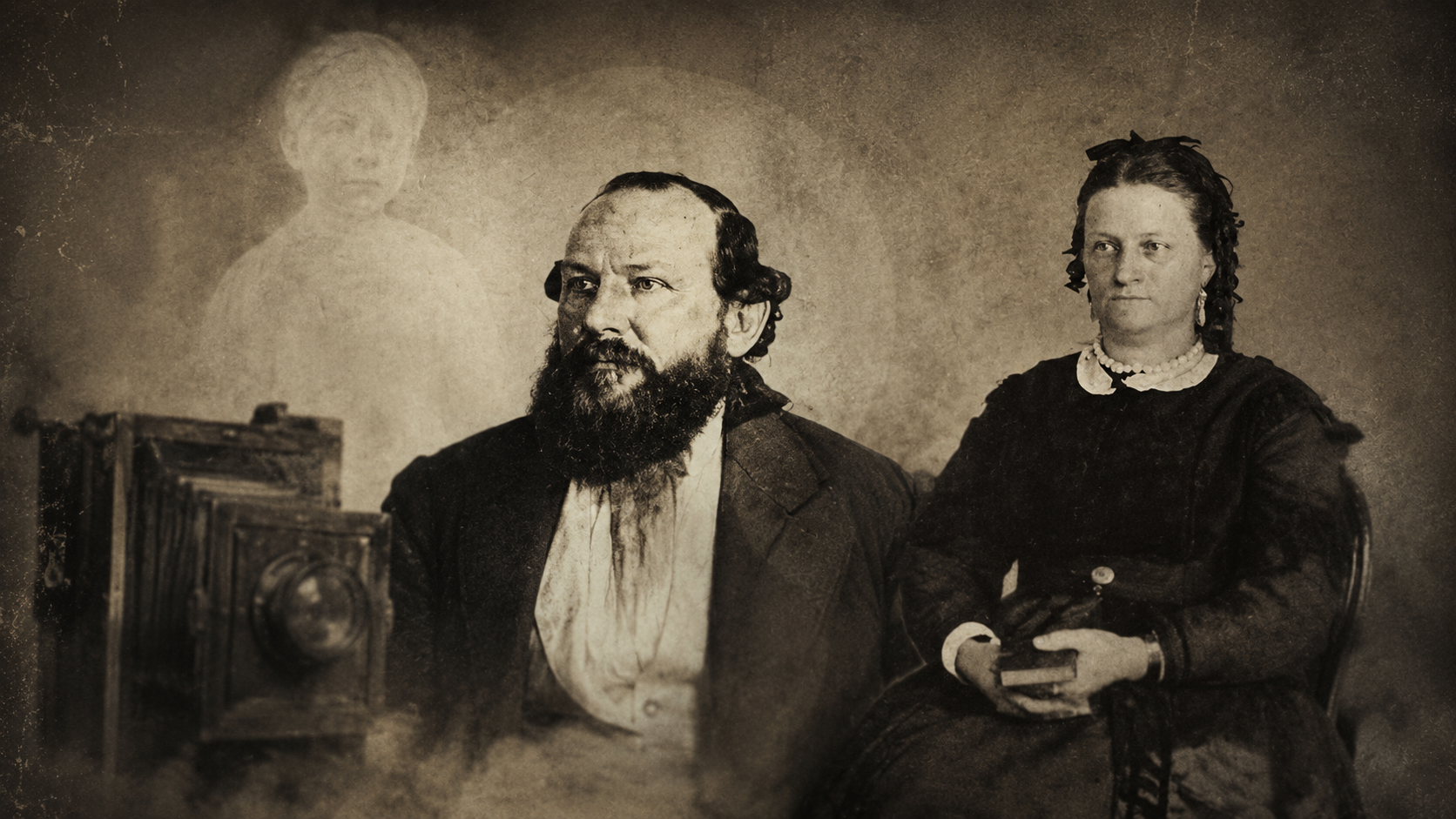
During ordinary portrait sessions, faint, ghostly figures began appearing alongside his subjects. Many grieving clients believed these mysterious forms were departed family members reaching out from beyond the grave. Mumler insisted that the camera could sometimes reveal spiritual presences invisible to the human eye.
Others strongly disagreed. Critics argued the images were simply the result of photographic manipulation, accidental double exposures, or deliberate fraud. The debate became so intense that Mumler was eventually brought to trial in 1869, where photographers, skeptics, and even the famous showman P. T. Barnum testified about whether his spirit photographs were genuine or cleverly manufactured illusions.

Although Mumler was acquitted, his reputation never fully recovered. Yet his photographs remain among the most fascinating artifacts of nineteenth-century America—not because they prove the existence of ghosts, but because they reveal something deeply human.
They show what can happen when revolutionary technology meets overwhelming grief.
This episode explores the remarkable story of William H. Mumler, the rise of spirit photography, and why so many people placed their faith in images that seemed to promise one impossible thing: another chance to see someone they had lost.
This version is suitable as a podcast description, blog post, or episode introduction. If you’d like, I can also make it feel more like a magazine feature or a cinematic historical essay.



Leave a Reply