
People who collect Marx trains rarely talk about them the way collectors talk about other brands. There is usually a story attached, often a fond one, and it gives the whole subject a personal glow. Marx never set out to make luxury trains. The company set out to make something fun that almost any kid could have, and that choice shaped everything that followed.
Louis Marx founded his company in 1919 with a simple belief that toys should be affordable. When Marx trains first appeared in the early 1930s, they carried that belief right into American living rooms. The early sets were made of lithographed tin with bright, almost cheery artwork. They were lightweight, simple, and built to take the rough handling that kids naturally give toys. If you dropped a Marx car down a staircase, chances were pretty good it would survive.
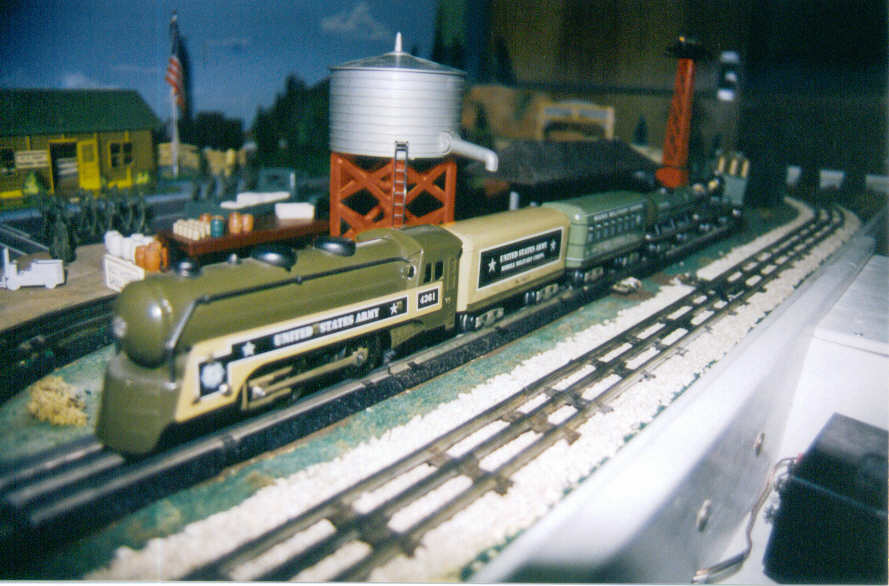
Imagine a kid around 1950, half awake on a cold December morning, creeping into the living room where the windows still show thin white frost. A Marx set is already running around the tree. The tin engine clatters along the track, and the freight cars behind it are painted in colors that seem louder than the room itself. He crouches down and presses a finger to the side of a boxcar, and the metal is cool and smooth. The train wobbles around a corner with a little bounce that feels alive. For that kid, the whole world fits inside the loop of track, and the sound of the locomotive is enough to make everything else disappear.
Scenes like that played out in countless houses because Marx kept its trains accessible. By the late 1940s and 1950s the company shifted into plastic shells and die cast parts, giving the trains more weight and detail. Department stores used them in window displays because they worked reliably and had a friendly look that pulled people closer. Marx made both O gauge and HO gauge, so the trains reached beginners and seasoned hobbyists at the same time.
The company struggled as it moved through the late 1960s. Manufacturing costs rose, the toy market shifted, and the original Marx operation eventually collapsed. Even so, the toys themselves kept showing up in attics, basements, and holiday boxes, waiting to be rediscovered.
Today those rediscoveries are part of the fun. People are drawn to Marx for different reasons. Many want to reconnect with their childhood or with a parent or grandparent who once set up a loop of track on the living room floor. Others appreciate the design itself. The tin lithography has a personality that feels cheerful and slightly stylized. The plastic era pieces feel sturdy and optimistic, like something pulled straight from a mid century catalog.
Because Marx produced huge numbers of items, most pieces remain budget friendly, which makes the brand perfect for new collectors. At the same time, there are gems to hunt for. Early Girard items, Joy Line pieces, odd color variations, unusual lithography patterns, and high grade boxed sets can all spark real excitement among advanced collectors.
The current market reflects this mix. Common Marx trains are easy to find and still affordable. Rare versions continue to rise in value, especially when the colors are bright and the boxes are intact. Many hobbyists now fold Marx trains into holiday villages or retro themed layouts because they run well and lend a warm, nostalgic mood.
Part of the appeal is that Marx trains never pretend to be something they are not. They are toys first, built for hands that were small and eager, and that spirit clings to them. When you pick up a Marx car today, it is easy to imagine that long ago kid, the cold floor under his knees, the clatter of the engine looping around the tree, and a whole imagined world opening right in front of him.
Examples of Collectible Marx Trains
Girard and Joy Line Pieces
Early Girard era tin often features rich lithography with a folk art feel. Joy Line trains from the early 1930s are smaller and more primitive but represent the true beginnings of Marx railroading. Clean boxed sets stand out in the market.
Color Variations
Marx occasionally produced locomotives and cars in unusual colors, sometimes for short promotions or store exclusives. These unexpected shades are prized by collectors who enjoy finding the unusual.
Lithography Differences
Small shifts in printed design, such as door track placement or roof graphics, often mark changes in factory tooling. Some variants are scarce and attract strong interest.
Noteworthy Sets
Certain military and space themed outfits from the 1950s and early 1960s continue to be sought after. Allstate space sets with their rocket inspired cabooses are favorites. Large dual powered diesel sets also sit near the top of the Marx market.
Tips for New Collectors
Choose What Appeals Most
Marx trains were designed to be fun, so let visual appeal guide early choices. A collection built on enjoyment tends to grow naturally.
Look Closely at Condition
For tin items, seek bright color and minimal denting. For plastic pieces, avoid cracks and missing steps or handrails. Engines should roll smoothly when the wheels are turned by hand.
Keep an Eye Out for Boxes
Original packaging adds surprising value. Even common cars become more desirable when paired with the correct box and insert.
Expect a Wide Range of Prices
Common cars may cost very little, making it easy to explore. Rare variations, early pieces, and high grade boxed sets can reach into higher prices, but most of the Marx world remains inviting for any budget.





Leave a comment