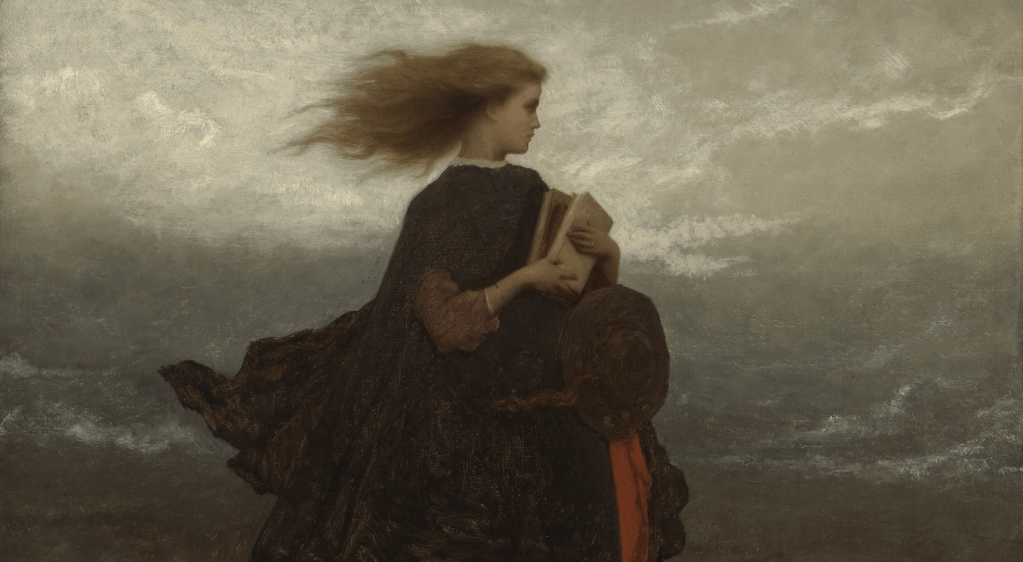
Eastman Johnson’s The Girl I Left Behind Me (1872) at the Smithsonian American Art Museum is more than a portrait—it is a moment suspended in time. It’s a captivating image – the girl stands at the edge of a foggy bluff, hair torn loose by the wind, her books clutched as if they could anchor her against the invisible forces pressing upon her. A wide-brimmed hat is held tight in her hand, and behind her, a splintering fence vanishes into gray emptiness.
Unlike Johnson’s more familiar subjects—presidents, pioneers, children at play—this figure is nameless. Her story is suggested only by the title, borrowed from a soldier’s marching song. The tune once carried men off to war, but here, the cheer is gone. The girl embodies those who remain, carrying the weight of absence and the tension of uncertain futures.
The painting’s wind and turbulence are more than technical flourishes. They make visible the unrest within her and the impermanence of life itself. Visitors often comment on the almost-living quality of her hair, the way the fog seems to shift if you linger long enough, or the fleeting shape of a figure in the distance. The gallery’s cool marble halls only amplify the painting’s quiet power, as though the building itself remembers the centuries that have passed.
Johnson’s girl has waited since 1872. She waits for the return of someone lost, for time to catch up, for the world to resolve the uncertainty that presses upon it. In her, the turbulence of history and the fragility of hope are frozen in oil and canvas, a story that refuses to stay silent.





Leave a comment