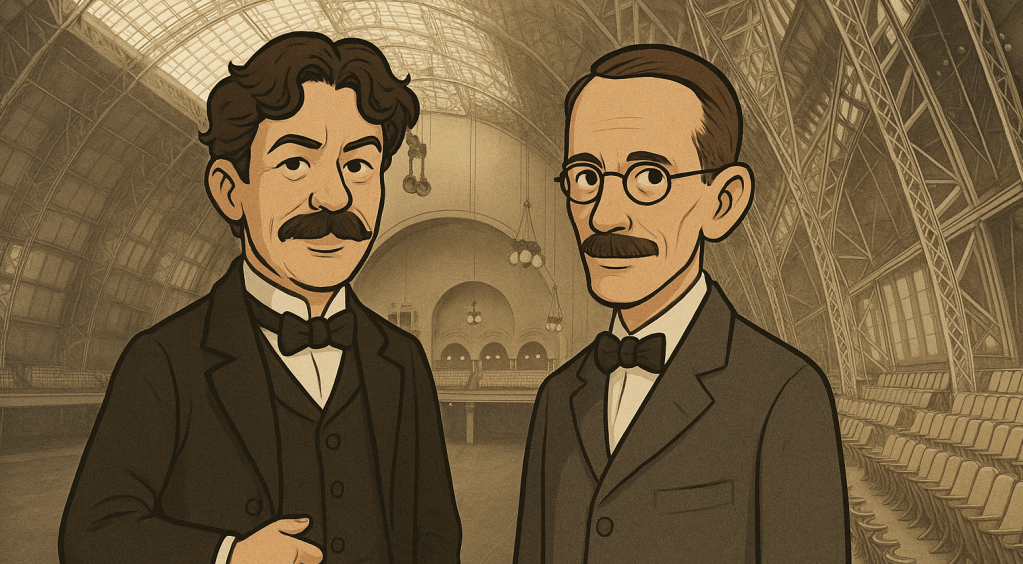
Two revolutionaries in American art, Robert Henri and Arthur B. Davies, helped redefine a national style—only to see their reputations fade as the American view remained stubbornly narrow.
“The object isn’t to make art, it’s to be in that wonderful state which makes art inevitable.” —Robert Henri
By the time of the 1908 show Eight American Painters, American art was undergoing a dramatic shift. Artists like Henri and Davies were beginning to see the world—and their work—differently. The Ashcan School stood at the forefront of this transformation, pushing the boundaries of what was considered acceptable.
Henri, widely recognized as the Ashcan School’s leader, and Davies, whose style diverged from its gritty realism, both played pivotal roles in reshaping American painting. But it was Davies who did the most to broaden the national perspective—revealing, in turn, the limitations of American artistic vision.
Within a few years, their once-radical approaches began to seem outdated, as European modernism swept into and transformed the American art scene.
Roads to Modernism
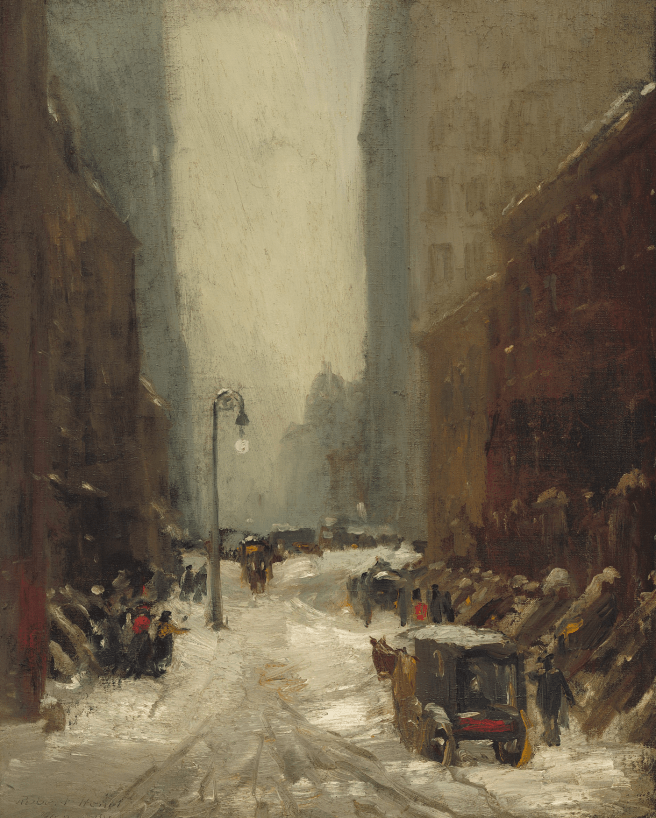
Henri’s work directly challenged the genteel, idealized subjects that had long dominated American painting. His philosophy was simple but revolutionary: art should reflect the world as it is—unflinchingly portraying the realities of modern life. He believed the artist’s role was to capture the energy, grit and rawness of everyday existence, particularly in the lives of working-class New Yorkers.
The Ashcan artists, however, often took what they saw at face value—portraying their subjects not as victims of industrial life, but as urban dwellers living, loving, and embracing the chaos of the city.
Henri’s influence was vast. With dark tones and loose brushwork, he encouraged his students to paint ordinary people in ordinary settings. This marked a stark departure from the academic tradition, which favored polished, idealized images of aristocracy, landscapes and historical scenes. Artists including George Bellows, John Sloan and Everett Shinn adopted this style, helping define a raw, unfiltered realism in American art.
Critics and audiences used to genteel portraits and mythological scenes were shocked by Ashcan art’s focus on slums, crowded streets, and mundane daily life. Critics called the work ugly, vulgar even immoral.
This clash was evident in the reactions of academic artists like William Merritt Chase, who declared, “Art has to be beautiful. That is its purpose.” And Kenyon Cox, writing in 1906: “We are told that art must reflect the life of its time. Very well—but must it reflect its vileness, its coarseness, its vulgarity? Is not the function of art rather to idealize life, to ennoble and uplift?”
The National Academy of Design, the bastion of American academic painting, frequently excluded Ashcan work from its exhibitions. This institutional resistance pushed Henri and his circle to hold independent shows.
Emphasizing artistic freedom, realism, and direct engagement with modern life, the Ashcan School’s independent exhibitions—especially the landmark 1908 show of The Eight—helped create the cultural conditions that made the 1913 Armory Show possible.
A Broader Vision
While Henri led the Ashcan School, it was Davies who helped change the trajectory of American art by introducing abstraction and European modernism to a new audience.
A painter who moved between symbolism and impressionism, Davies’ early work offered a romantic, poetic view of modern life—favoring idealized figures and allegory. Initially an advocate for visionary realism, Davies gradually shifted toward a more abstract and symbolic language, influenced deeply by European modernists like Matisse.
Davies may not have painted the future, but he opened the door to it.
His break from the past—through both his support of Henri and his personal exploration of new styles—eventually rendered his earlier work quaint. The work of Davies and the Ashcan artists, while once groundbreaking, was quickly eclipsed by modernist experimentation.
When the Armory Show opened in 1913, it introduced American audiences to European modernists such as Pablo Picasso, Marcel Duchamp, and Henri Matisse—artists whose abstraction, cubism, and radical color and form redefined the artistic conversation.

A Moment of Eclipse
To be fair, the Ashcan School was never a large or unified movement, and it lacked the cohesion and endurance of European Impressionism. Its focus on capturing the immediacy of American urban life was tied to a particular moment in time.
By 1913, the momentum had already shifted. The art world in New York was now in conversation with broader modernist currents, and the avant-garde had taken center stage.

Henri and Davies had very different reactions to this shift.
Henri, long frustrated with what he saw as “art for art’s sake,” remained committed to artistic freedom but was uneasy with pure abstraction. While he mentored artists inclined toward experimentation, he remained fundamentally a realist—believing that art must remain rooted in life and human experience.
Davies, by contrast, had already turned outward—toward Europe—and embraced modernism. Without his curatorial vision and tireless work behind the scenes, the American encounter with abstraction may have been delayed by decades. He called the show a necessary cultural shock, saying: “America must see what is happening in the world of art. It may rebel now, but it will thank us later.”
Legacy and Lineage
So whose impact was greater?
It’s hard to imagine the trajectory of American art without the 1913 Armory Show. To that end, Davies—along with Walt Kuhn and Walter Pach—had an immeasurable impact. His openness to the new and the foreign transformed American visual culture.
But Henri’s legacy lies in practice as much as revolution. As an educator, he instructed hundreds of students, including Edward Hopper, Rockwell Kent, George Bellows, and Stuart Davis. His influence is embedded in the American artistic conscience.
While 19th-century movements like Luminism and the Hudson River School emphasized idealized landscapes and often mirrored European styles, the Ashcan artists broke decisively with those traditions—focusing instead on real people, gritty urban life and emotional truth.
Henri helped define a distinctly American voice in art—rooted in the everyday—and anticipated the midcentury obsession with authenticity that defined Abstract Expressionism. Though a realist, he championed emotional honesty, individual voice and expressive freedom: values that would fuel the next generation of painters.
His insistence on immediacy and truth helped shift American art toward personal, emotional, and even psychological terrain. While the Abstract Expressionists abandoned representation, they inherited Henri’s commitment to truth over tradition.
This philosophy seeded new and bold experiments in American art, including Abstract Expressionism.
(And to this author, it seems art has wandered—without an obvious path forward—ever since.)
Thanks to Davies, it’s hard to imagine American art would have reached that point without the radical shock of the Armory Show.
Listen on Spotify https://open.spotify.com/episode/3EW3rHorUmJ8I01EF9MwPh?si=5-GRlHYHTh-mlKVkIXXxLA





Leave a comment