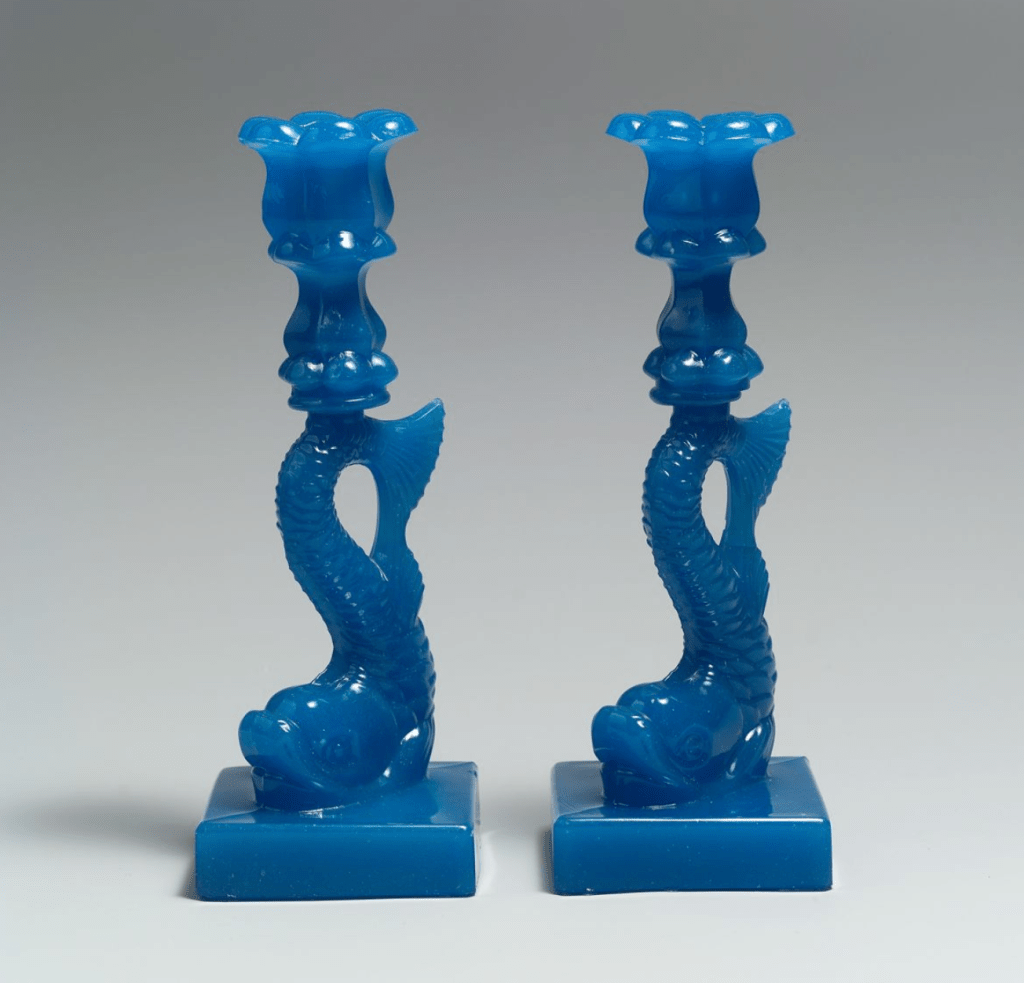
Diving into the Origins of the Dolphin Candlestick

Boston and Sandwich Glass Candlestick

Many people still use and love candles for their aroma and ambiance, but while some of us find it hard to believe, many others have never owned a candlestick. If we refer to candles at all, it’s more likely candles in jars, tealight candles, and even LED candles powered by batteries.

Candlesticks are an easy, affordable antique accent, however. From glass to brass and ceramic, there are countless forms and styles. Collecting them is often the pursuit of the unusual.

One of the forms that stands out is the pressed glass “dolphin” candlestick. You might know these as pressed glass or sandwich glass, but that’s not because two pieces of molded glass are sandwiched together. The name comes from the Boston & Sandwich Glass Company in Sandwich, Massachusetts.
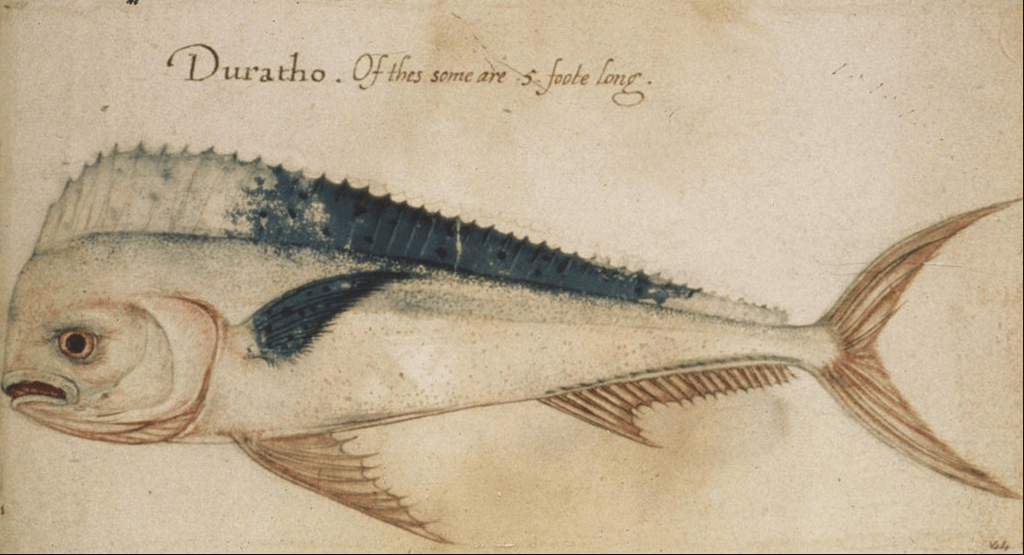
If you’ve seen one of these beauties, the word dolphin may confuse you as well. The dolphin in American design is not an accurate depiction of the dolphin at Sea World. As with many design elements adopted long ago, the origins are not certain. But we have our ideas.

The beasts on candlesticks we refer to as a dolphin may have derived from early drawings by a Roanoke settler named John White and may actually be derived from mahi-mahi.

When you see a mahi-mahi, it makes more sense than a dolphin!
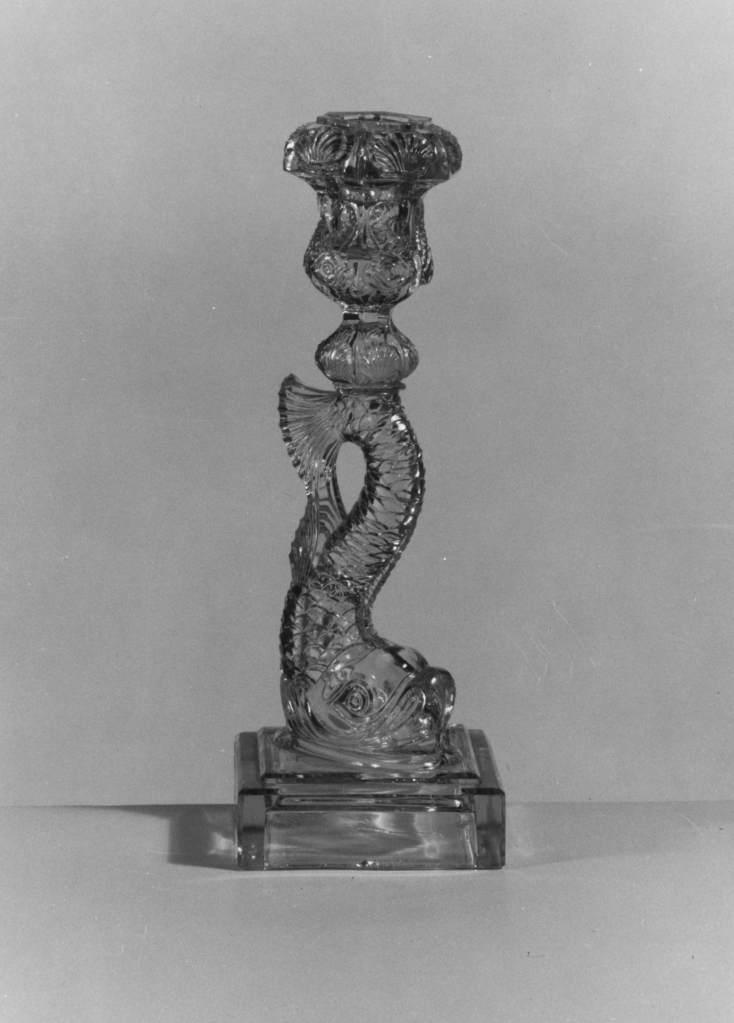
Boston and Sandwich began making candlesticks around 1827. Glass candlesticks proved to be very popular and soon other companies were making them in many colors and from clear glass.

Aside from color, a differentiating feature is the base. According to a 1969 publication from the Dallas Glass Club, the dolphin candlestick with a single or double square base is generally attributed to Sandwich. A hexagonal base more commonly has Pittsburgh origins. Bakewell Pears & Co. (Pittsburgh) and McKee & Brothers (Pittsburgh) are known to have made dolphin candlesticks in the mid-late 1800s.

Not everyone is certain colors and shapes can definitively be used to determine origins.

There is one that’s easy to identify. It has a square base and is marked with M.M.A. These are from the 20th Century and were sold at the Metropolitan Museum of Art gift shop. The Met calls them Koi Fish Candlesticks. These were made by Imperial Glass (Ohio).

The Met wasn’t the first to reproduce 19th Century candlesticks. As your search begins, you will realize they were widely reproduced at least into the 1960s.

The Corning Museum of Glass is also a good resource on dolphin candlesticks.

Westmoreland Glass (1960s) https://www.cmog.org/artwork/2-dolphin-candlesticks

1860s clear candlestick https://www.cmog.org/artwork/candlestick-50

Milk glass candlestick https://www.cmog.org/artwork/candlestick-42

Also, see the Sandwich Glass Museum.

Top Image: Public Domain Image, Metropolitan Museum of Art, Boston & Sandwich Glass Candlestick

,

Portland Art Events Calendar

Discover more from Urban Art & Antiques

Subscribe to get the latest posts sent to your email.

Response

  1. Robert S Burford Avatar

    Since ancient times, the dolphin has been regarded as a kind of personification of marine power. Its celerity and its jumps in the waves accompanying the ships certainly facilitated this analogy. The dolphin appears with its tail raised, with spiny pectoral fins, prominent scales, its mouth half-open revealing the sharp teeth from which the water gushed. With its reputation as a savior of souls, the dolphin’s legacy extends far beyond the borders of Greece. Across various cultures, this magnificent creature has been likened to Christ and to the revered Roman sun god, Mithras, whose worship waned with the spread of Christianity. From the Byzantine era to the Arab world, from China to Europe, sea people have regaled tales of dolphins rescuing sailors from shipwrecks, cementing their status as the quintessential guardian angels of the sea.
    The animal, mysterious and disturbing with a large head and threatening eyes, sharp teeth, a dorsal fin forming a crest, and a long sinuous tail well visualizes the monstrous character that Renaissance artists attributed to the marine world.
    Taranto [southern Italy] was founded in 706 BC by Dorian immigrants hailing from Sparta [Greece]. Like other Grecian colonies, it’s gold coinage often featured a frisking dolphin. Constantinople, required significant financial capital. The crusades brought an expansion of trade, and with that, Venice profited financially. This financial advantage secured Venice’s standing amongst the trading nations for a very long time.
    Commerce of Venice was carried by ship all over the world; Venetian mariners believed in the Dolphin and it became a symbol of prosperous, adventurous city dominating the Seas. And dominant Venice was the principle state of the Italian peninsula and beyond. And the porpoise blessed their enterprise.
    Venetian Glass: “By the late 1200s, the production of glass objects of the finest quality was the city’s major industry as confirmed by the establishment of the Glassmakers Guild that laid out rules and regulations for the craftsmen. The purpose of the guild was to safeguard the secrets of the trade and ensure the profitability of the industry. In line with these objectives, a 1271 law prohibited the importation of foreign glass or the employment of foreign glassworkers. An even more radical law was passed in 1291 that laid the ground for the establishment of Murano as a premier glass-manufacturing center. This law required that all furnaces used for glassmaking be moved from Venice to [island of] Murrain to avoid the risk of fire from the furnaces spreading onto the largely wooden structures of overpopulated Venice. Many historians agree that the true motive for this law was to isolate the glass craftsmen to a location where they wouldn’t be able to disclose trade secrets. A subsequent law passed in 1295 forbidding the glassmakers from leaving the city confirms this theory.”
    In the 17th and 18th centuries, Venetian glassmakers were making amazingly intricate creations in stemware, by the 19thC settling on simpler motifs like a lone dolphin.

    Like

Leave a comment

Antiques Mysteries and Great Paintings from Urban Art Antiques | Listen Notes
