
Before heading to the exhibition Echoes of the Past: The Buddhist Cave Temples of Xiangtangshan at the Meadows Museum on the SMU campus, I did not know what to expect. Almost every sculpture in China’s Buddhist temples was remade after nearly one hundred years of negligence either from natural disaster, military or political turmoil. Most Chinese Buddhism devotees do not seem to be bothered whether a temple or a piece of Buddha sculpture is from the 6th century or merely 20 years old. The oddly contradictory fact that the same enthusiastic Buddhists who reject and deny the existence of the material world have to rely on such physical objects for religious expression may contribute to the lack of notion of cultural preservation in the whole country. Yet the influence of Buddhism is so profound that even in the eyes of non-Buddhists like me, the very image of a seated Buddha has become only an iconography and lost all the details to the notion of religious indoctrination. After all, one Buddha is no different from another when you are 20 feet away at the prayer podiums and how dare you inspect the color gradation when surrounding people are busy kneeling and burning incense?
Thus perhaps it is not surprising that such sculpture works from American and British museums abruptly cut off from the century’s religious linkage and stripped of their in-situ usage, may ignite scholarly interest in the artistic expression and transformation of Chinese sculpture.
The cave temples at XiangTangShan are from the Northern Qi Dynasty, one of many regimes in the 5th and 6th centuries when China was controlled by a succession of feudal governments, none of which lasts long. (There are in total six emperors during the merely 26 years’ history of the Northern Qi Dynasty.) Interestingly, political chaos does not lead to artistic suppression. On the contrary, this is the period that witnessed one of the greatest migration movements in China, and hence cultural confluence. While, in many cases, the ruling class was minority people, the Sinicization harmonized the whole region to become what it is now China.
I have never seen sculpture works from the Northern Qi period before except in textbooks. The scarcity is one factor, the adjacency to the Northern Wei and Tang Dynasties, both of which were famous for their popular Buddha sculpture groups, is another.
This group of Buddhas in the exhibition makes it apparent how Chinese sculpture evolved through the lineage of Northern Wei, Northern Qi, Sui, and Tang Dynasty. Although transitioning is never an appropriate word for summarizing the art of any period, Northern Qi sculpture sits between the lean and angular Northern Wei style and the voluptuous Tang style. In particular, the techniques used to carve the clothing are stunning in a few examples. Unlike those in the Northern Wei period, when robes seem to be lifted up to form harsh-edged triangles as if the Buddha is descending from the air, the clothes depicted at the exhibition are fully 3-dimensional yet more naturalistic. In general, they form a tube shape around the body with many subtle layers gradually opening up from beneath the waistline. In the upper body, the creases and folds of clothing are very shallow. The jewelry necklaces, worn by a few, stand out with their elaborate depth and details. At the very bottom, the robes extend only slightly. The wave-shaped edge created by each fold adds a convincing depth to the volume.
Most Buddha possesses a calm facial expression and one may detect a hint of a smile in quite a few. Yet the overall body rendering seems overly round. The hands and especially the feet seem so bloated that the lack of convincing anatomy makes the whole figure clumsy and wooden. Considering heavy feet and tubular legs are stylistically common from the Northern Qi period, it can only be concluded that such a feature must be officially supported and statewide copied.
For me, it is amazing to be so close to such sculpture and really look at such ancient sculpture works. Above all, what surprised me the most is how foreign these Buddhas actually look. They have sculpted faces and straight noses, a reminder that Northern Qi is governed by the Xian Bei people, a minority from the North. Although nowadays no one can explain the origin of these disappearing people, some literature from Tang Dynasty has stated that the Xian Bei people should be painted with blonde hair and blue eyes. If so, the sinicization effort of the ruling class is evident in those officially-approved ideal faces with softened facial features that are borderline between Western and Asian looking.
Based on the research at the Center for the Art of East Asia at the University of Chicago for the past seven years, all the sculpture works at the exhibition should or may come from XiangTangShan, a southern town in Hebei Province. As stated in the website, when Western countries expressed interest in ancient Chinese sculpture in the early 20th century, dealers carved them out, or in some cases, chiseled hands and heads out if the sculpture proved too big to move. The works in the exhibition came from two continents and seven museums (the Asian Art Museum of San Francisco, the Cleveland Museum of Art, the Metropolitan Museum of Art, the University of Pennsylvania Museum of Archaeology and Anthropology, the San Diego Museum of Art, the Victoria and Albert Museum, and the Virginia Museum of Fine Arts). It is ironic that the centerpiece of this exhibition is a digital recreation of one of the largest cave temples, with some objects marvelously placed back to where they are supposed to be, only in the digital realm. Since most of these objects are looted between the 1910s and 1930s, they are not subject to the 1970 UNESCO Convention on the Means of Prohibiting and Preventing the Illicit Import, Export, and Transfer of Ownership of Cultural Property. (And I am sure that museums have no intention to return such objects.) Had the origin of these objects not been found and caves non-existent, they would be treasured as the remnant of the Northern Qi art, but for now those heads and hands speak an incomplete and sad story. Some texts I read in the exhibition seem to emphasize the permanent damage done to those ancient cave temples for the past one hundred years and the fact that such objects are at the hands of major American museums seems to at least protect them from the turmoil, yet as a Chinese, I feel that had it had no demand, it would have no supply. Those fragments or complete works would not have left their original locations had Western art historians and scholars truly understood art preservation and cultural heritage back then.
It reminds me of the famous story of the statue of Wesirwer at the Brooklyn Museum, whose head (at the Brooklyn Museum) finally joined his body (at the Cairo Museum) after more than two millennium’s separation, for a brief period. Will that path be possible?
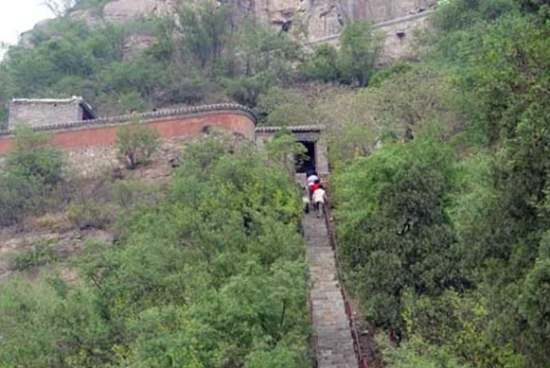
There is also a video program that shows the modern-day pilgrimage at the cave temple. The sky is perennial gray, the air muggy. Peasants are still plowing although chimneys are not too far away. A steep and long stairway leads to the cave temple on the cliff. Caves are mostly empty, and yet people are still kneeing and burning incense, as has been done through hundreds of generations. In a long way, the exhibition starts its purvey at the artistic values and cultural background behind these sculpture works, but eventually, it leads one to their purest function – worship.





Leave a comment