Back in February, A large painting by Edward Mitchell Bannister was for sale in the Swann Auction Galleries. It was, according to the auction catalog, the largest painting by the renowned African American painter of Barbizon school came to auction, although Renwick Gallery (a branch of the Smithsonian American Art Museum near the White House) is showing several his paintings in the Grand Salon, all of which feature stunning size that devours viewers into his pastoral scenes.
When Geo and I went to examine the painting in person then, we noticed a few condition problems: discoloration, abrasion, craquelures and paint-loss. Had it in a better condition, it could have set a new auction record. Still, the painting fetched $33,600, a signal which disagreed with Mrs Straub’s remark that market availability is a key for growth as Bannister’s paintings rarely come to market.
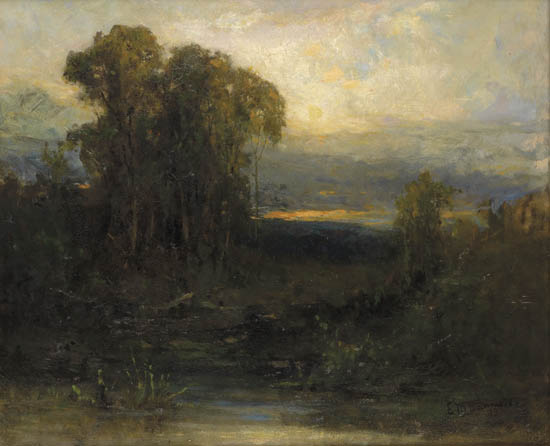
Today, another painting went under the hammer in the Swann Galleries. Signed and dated in 1883, this painting is less about pastoral than American wilderness. Yet the nostalgia dusk clouds and the dark color pallet are undoubtedly the artistic language of Bannister’s era.
I have found the painting particularly charming. The sky is still lit by the setting sun, the glorious golden light can be felt from the colors of the tops of the trees; yet the tree trunks and pond speak of the evening shades. Viewed from a perspective that one can neither walk into it, nor walk out of the ephemeral moment, the picture is an eerie combination of cold and warm, familiar and unknown, nostalgia and presentiment. Moving to Texas recently and living right by a lake, the wilderness in nature and geographical lonesomeness are brought up to me by a painter from Northeast.
Even with Charles G. Calder’s provenance, the auction house gave the medium-sized painting a conservative estimation, between $8000 to $12,000. Today it was sold for $21,600 (with 20% buyer’s premium).





Leave a comment