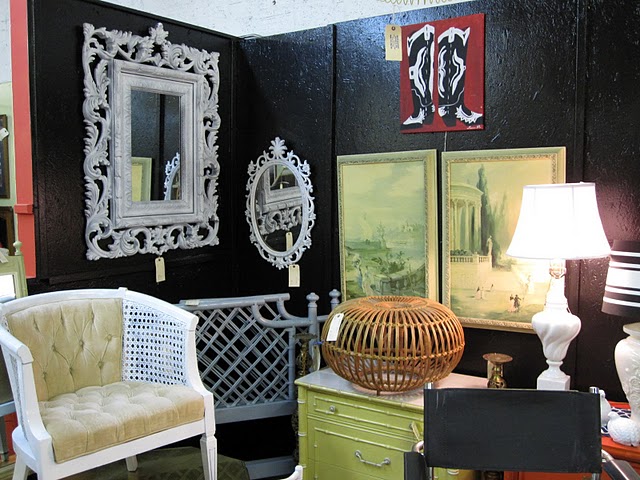
 I know of several cities that have “antique districts,” but none seem to have the mass of the Trinity Antiques District in Dallas. A map handed to us at the first stop, a higher-end mall called Lost…antiques, lists more than thirty shops and more than forty points of interest, including UPS and several restaurants. Time didn’t permit visiting them all, however.
Comparing what’s available in the Dallas area to finds in the Northeast and Mid-Atlantic regions, generally the merchandise weighs heavily on English and secondarily French imports. Most of what’s on display in Dallas seems to have arrived on containers from Europe. One shop, Lots of Furniture, offers a large selection of brown, carved furniture, mostly oak circa 1890-1910. While I did yearn to find more things American, the fact that it has to warrant traveling the Atlantic generally helped maintain a minimum quality level.
Mid-Century modern also seems just as popular here as it is in New York and elsewhere. Much of this merchandise has local origins and an easier point of entry into a shop (since it doesn’t have to be shipped). Several stops in the district cater to the 20th Century furniture crowd including Collage and Lula B’s. The later is a recent addition to the district and will re-celebrate its opening March 19 with live music, libations and food.
There were a few American pieces from before the mid-century modern period to be found, including a bookcase and carved center table in Lost…antiques and an empire chest here and there. Still I wonder why the tastes in Dallas lean so far to the other shore when in not so far away New Orleans mahogany, most of it 30-70 years older, demands a great premium over oak. It was explained to me that buyers in Dallas go for a look—they aren’t collectors, at least not in the numbers found elsewhere.
I’m not sure to what extent that’s true. For antiques, as I understand them anyway, what they are is at least equally important as how they look. Perhaps it’s a distaste for the big Northern cities like Philadelphia, Boston and New York that accounts for the prevalence of European furniture, combined few local objects being produced before 1900 compared with say Kentucky or South Carolina. I could be off on that statement, but these are just general observations made when knowledge of antiques and collecting in Texas is in its infancy.
http://picasaweb.google.com/s/c/bin/slideshow.swf





Leave a comment