
I was searching around for a painting that would relate to Thanksgiving. For reasons I’m not certain of, the first to come to mind is Edward Hicks’ Penns Treaty with the Indians. William Penn and the Indians don’t really relate to Thanksgiving specifically, but in my mind, there is some connection.
First, the Indians seem to have celebrated the harvest, an event that came to be known as Thanksgiving before the Puritans arrived. Moreover, I think had Penn been in charge of relations with the American Indians, things might have worked out much better.
Penn of course was a Quaker. As such he, like other Quakers, believed in Jefferson’s words that all men are created equal—even before Jefferson wrote them. Quakers refused to bow or take off their hats to social superiors and refused to swear oaths of loyalty to the King.
The New England Puritans, while momentarily content feasting with Wampanoag Indians, were especially hostile towards Quakers.
The king had different affections. After a group of prominent Quakers purchased the colonial province of West New Jersey, the King granted an extraordinarily generous charter which made Penn the world’s largest private landowner, with over 45,000 square miles.
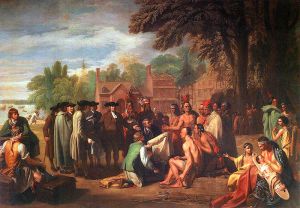
Penn first called the area “New Wales,” then “Sylvania,” and set out to lay the legal framework for an ethical society where power was derived from the people, from “open discourse,” in much the same way as a Quaker Meeting was run. The idea of owning land, however, was new to the Lenape.
When Penn arrived, the Lenape people could not recall a time they did not live on this land. Their villages dotted the shores of streams and rivers near the forest’s edge. Tradition taught them to hunt game, plant corn, and honor the spirits who protect all living things. They knew other natives as enemies and as friends. They called themselves the Lenape, the Common People. Lenape teachings said land existed as a gift from the Creator for all to share, just as the air, sunshine, and water.
From modern eyes, Penn, like the others, was busy dividing up land others had been living on for centuries. The difference is he did it by contract and paid for it. Yet, like Jefferson’s words in the Declaration of Independence, even today we see in several images of William Penn’s Treaty with the Indians foundations for the building of a nation, a society with at least an awareness that actions should be ethical, and a future for a nation ruled by written contracts. Of course, everyone along the line wasn’t interested in these ideals, but this is about spirit and intent, not success in living up to it.
It would be interesting to see these paintings through the eyes of a Lenape descendant. I wonder if someday we, as a 21st-century people, can look at them, embrace the spirit and, at least for a moment rise above the more unfortunate aspects of our nation’s past.





Leave a comment