The great number of existing beautiful landscape images with distinct artistic forces seems to contradict the fact that traditional landscape painters have little variety of arsenal to use: Light and shade, the nearly opaque forest, and the translucent aerial perspectives. Arnold Grabone had even less means because of his exclusive use of a palette knife. On the one hand, the texture of his landscape paintings shows a psychological map of his thought process, thus adding an extra layer to the visual pleasure; on the other hand, neither the luminist haze through glazing nor the vibrant chalk-like brushstroke can be easily obtained through knife blade.
For Grabone, some subjects with irregular terrain and rough texture, provide certain advantages to his style. In those Alps mountain views, the pressing, wiping, and scratching of paint creates clashes and joins of different facets, engendering giant rocks and cliffs with scintillating radiance. The paint, sometimes so thick that it retains the relatively stiff form, is in the primal forms of different directions, burliness, vigor, and characters. In short, the paint comes alive.
If Alpine’s towering ridges and summarily grandeur make the use of palette knife technique a natural artistic instinct, Grabone’s landscape of a pond and boat shows his deft skills freed him from subject limitation and he could paint any scenes that spoke to him.
The intimacy in this landscape painting lies in the painter’s reflection of picturesque attractiveness and his absorption of geographic accuracy. But it is overall less textural in nature and more harmonious in light and tonality. The pond is neither tranquil like a mirror nor rippling and glistering. While the opaque paint gives the volume of the forest, the subtle light which is diffused through branches and bounced from the water surface provides a technical challenge to the in general heavy-handed palette-knife style.
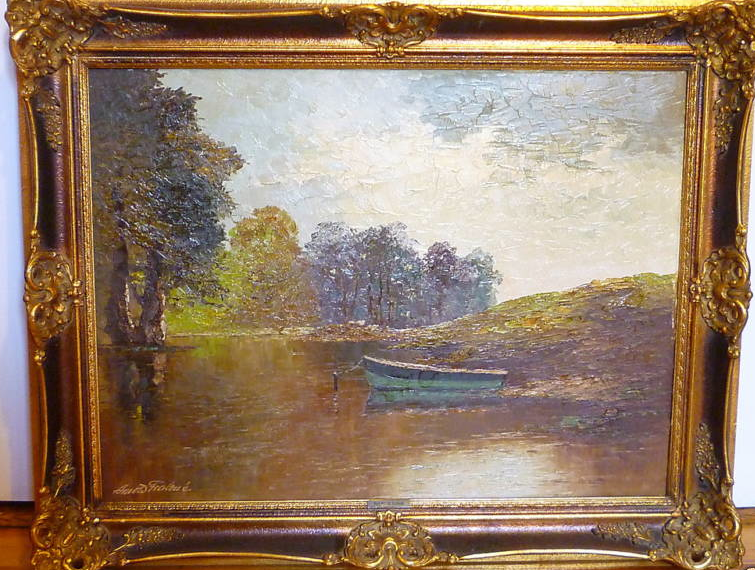
Grabone responded to it with a variety of methodologies that were different from his more typical Alpine scenery. The impasto in the foreground is so light that the warm brown under paint can be seen at certain areas of the water’s surface. The freshness of the foreground trees comes from his confident use of blades to paint and blend raw paint directly. It is joyful to observe yellow, ochre, and olive green paint to superpose, juxtapose, and twist with each other like playful spirits. The reflection on the far side of the pond is suggested with shorter and harder strokes. Patches of opaque colors form naturally with smooth edges since the painter probably finished the whole painting in one plein-air session and wet-on-wet was the only choice.
Cloudy sky is typical in Grabone’s seascape paintings. It not only reduces the contrast but also justifies the choice of richer tonality of the picture. The boat, the center point of the picture, seems greener than anything else. Perhaps, in Grabone’s mind, the utmost serenity lies in nature when humanized.





Leave a comment