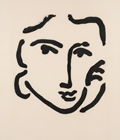
The Baltimore Museum of Art is presenting the first comprehensive exhibition on the printmaking of Henri Matisse. On view October 25, 2009 – January 3, 2010, Matisse as Printmaker unites the BMA’s extraordinary collection of Matisse prints with a traveling exhibition organized by the American Federation of Arts, a non-profit arts organization, and the Pierre and Tana Matisse Foundation. The BMA’s exhibition features approximately 170 works of art spanning 50 years of Matisse’s career. More than 150 prints, as well as a selection of related paintings, sculpture, drawings, and books are included, providing compelling evidence of the important role printmaking played in the evolution of Matisse’s visual ideas.
Matisse as Printmaker loosely follows the chronology of Matisse’s career, from the artist’s earliest print in 1900to the last in 1951. Examples of every printmaking technique used by Matisse—etchings, monotypes, lithographs, linocuts, aquatints, drypoints, woodcuts, and color prints—are included. Almost all of the prints involve serial imagery with the artist showing the development of a reclining or seated pose, the integration of models within interiors, the study of facial expressions, and the transformation of a subject from a straight representation to something more
abstract or developed. Illustrated books such as Poésies de Stéphane Mallarmé (c. 1932), Pasiphaé (1944), and Jazz (1947) demonstrate Matisse’s brilliant innovations in the presentation of serial imagery. The artist’s brief experimentation with color printmaking is represented with three impressions of the color aquatint Marie-José en robe jaune (1950) and a print titled La Dance (1935), which captures the composition of his first version of the mural intended for Albert Barnes. Though most of the exhibitions and research to date have focused on Matisse’s painting and sculpture, the rich variety of media and subject matter in Matisse as Printmaker significantly advance the scholarship and public awareness of this understudied aspect of Matisse’s oeuvre.
The exhibition comprises 63 prints from the collection of the Pierre and Tana Matisse Foundation, with artworks bequeathed by Henri Matisse to his younger son Pierre (1900–1989), an eminent dealer of modern art. These prints are complemented with a selection of works from the BMA’s world-renowned Cone Collection formed by Baltimore sisters Claribel and Etta Cone. Additionally, many of the later prints in the exhibition are from a recent gift to the BMA from the Pierre and Tana Matisse Foundation and are being shown for the first time. These works are a major addition to the BMA’s collection as they bring the Museum’s representation of Matisse’s prints to more than 400 images, plus all but one of his illustrated books, making it the most important collection of the artist’s prints in North America. These works are rarely on view to the public due to their sensitivity to light. There is no admission charge for this exhibition.





Leave a comment