There are two kinds of regret as a collector. You regret things that you have just bought. Or you regret for things that you didn’t buy, which has haunted you ever since.
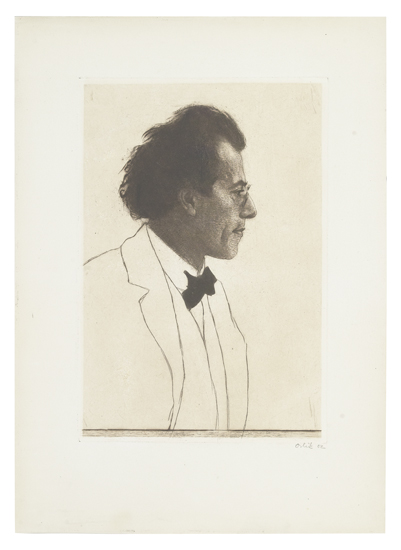
The latter case happened recently with Swann Galleries auctioning “19th & 20th CENTURY PRINTS & DRAWINGS.” Among them, Lot 68 featured an etching and drypoint print of Gustav Mahler by Emil Orlik.
————————————
The music of Gustav Mahler came late in my life. The Mahlerian Mahler-mania started from the middle of 1990’s in China. I have not grown to love his music unequivocally. (For example, I have yet to feel connected to his Symphony of a Thousand.) But enough of his music has influenced me profoundly. I may quibble a little about the abuse of Tchaikovsky’s Nutcracker Suite during the Christmas season or using Mozart’s string quartets as dining music. But the monumentality of Malher’s music commands listeners wholehearted attention and devotion. The irony, ambiguity, extremity and “lengthy” compactness of human emotions makes each listening experience a journey anew.
Just 100 years ago, Mahler was the music director of New York Philharmonic. The Mahler Symphony in Sequence was the pinnacle event in the last season at the Carnegie Music Hall. The companion brochures (which I didn’t throw away) contain pictures, stories and anecdotes. A quick search online shows that numerous photos, cartoons, paintings and letters are available for further study. Unlike Sebastian Bach, or even Beethoven, the number of first-hand materials related to Gustav Mahler is abundant. This is a true blessing for Mahler fans who can eventually own a piece of Mahler that freezes the music torrent into something more tangible.
————————————
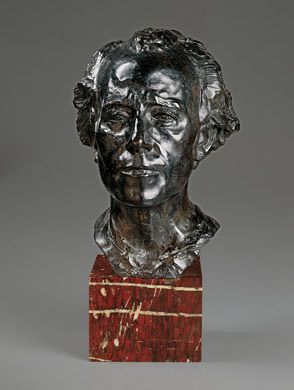
Mahler was not attractive. His forehead is broad, his nose protruding, his eyes small but sharp. That makes an impressive portraiture, but also elicits temptation of exaggeration or caricature based on strong facial features. My first encounterance with Mahler portraiture was in the National Gallery of Art. A bronze statue made by Rodin was once treasured gift of Walter Bruno, the protege of Mahler. Without eyeglass, the composer, with his head tilted slightly upward, seems to fall into his own thoughts. It is a convincing work of art that penetrates Mahler’s physiognomy into a realm of his psychic predisposition. In fact it is hard to read this portraiture, as much as his music, but I could not deny the eminent presence of his peculiar spiritual and intellectual characteristics.
————————————
I knew nothing about Emil Orlik when I spotted the print in Swann Auction Galleries last Saturday for the preview. If I was immediately drawn by the iconic face, Eric could spare such sentimentality and delve into the artistic merit directly. It is a daring image. The modeling of the head is meticulous and intricate, yet his upper body is merely suggested through a few lines. The incongruity portends the prowess and discipline possessed by the artist to guide the viewers into a state of being higher than mere photographic realism. Those succinct lines, seemingly unconscious, are inspiration and spontaneity crafted to the highest degree of precision. Thus while my eyes didn’t move away from the profiled face, Eric admired as much the simple lines as the whole design.
Thanks to internet, it took me no time to find the information about Emil Orlik and his friendship with Gustav Mahler. The article – “Emil Orlik and Gustav Mahler: A Meeting of Minds“, written by Jan Hoeper is fascinating to read. I did not want to copy the article here although two important facts were more directly related to this print.
First, Orlik initially sketched Mahler during a live conversation on a postcard which not only pleased the maestro but also was sent right away to Mahler’s sister. Orlik was then invited to visit him in Vienna, which probably led to this famous drawing.
Secondly, the fluidity in the “calligraphic pen-and-ink style” is the fruitful result from Orlik’s two years journey in Japan. Mahler’s own music is also influenced by the orientalism which consummates in his “Song of the Earth.” Both artists absorbed the oriental elements into the traditional western art. The wonderful portrait is perhaps the best record of the meeting of the two minds, with so much similar background (both Jewish, and both born in today’s Czech Republic) and shared taste.
————————————
Nor do I have enough knowledge in print-making to tell the quality of an impression. In fact, I didn’t know the difference between etching and dry-point although I sensed the finer lines in this print provided some advantages to the artist and led to an almost chiaroscuro effect. Curiously, another group of prints that I loved in the auction were also done with dry-point technique by American print-maker Armin Landeck. Auction preview is a place to exercise and test expertise and knowledge in certain fields, but probably it was a little bit too late to learn the difference in print-making on-site.
Another question I had was the edition number. It is a natural and legitimate question to ask with regard to print collecting. The auction house told me that they didn’t know how many impressions existed based on their body of knowledge. A website devoted to the prints of Orlik confirms that there was no published edition.
With all these uncertainties in my mind, I left an absentee bid, which as the title said, was not high enough. From a collecting point of view, I always think it is actually preferable not to get the first hunting prize in a new field so that the interest and passion can be tested over time, while the knowledge can be further enhanced. Falling in love at the first sight is romantic, but collecting is not dating and marriage with the goal of life-long harmony and enjoyment (albeit sometimes “divorce” may happen”). In this case, the second look or third look is more important. The question is: Can I find another piece of Mahler by Emil Orlik?





Leave a comment