At the Brooklyn Flea in Fort Greene, I have been amazed by the young crowd in front of the poster booths. Movie posters are perfect for a modern-looking New York apartment. For young collectors who have just started their careers, spending 50 dollars or so on a giant picture of “Silent Lamb” or “Vertigo” not only decorates rooms beautifully but also reflects personal tastes in a popular, yet no-nonsense way. There are also dealers and auction houses selling vintage posters including at the Baltimore Antiques Show, Stella Armory Antiques Show, and reputable Swann Galleries. The vintage posters, although still affordable, are more much serious than reproduction ones sold at some souvenir stores or antique malls. It is here that expertise and experience are needed with regard to the valuation of vintage posters.
Modern reproductions are usually photo-engravings, which can be identified by their dot pattern. A magnifying glass can help, but probably expert explanations and comments work better. Also, a lithograph is a drawing or design done with a grease pencil or crayon on a certain type of stone. Vintage posters are reproduced in limited numbers when using this technique. However, modern lithography uses chemicals and zinc or aluminum sheets, which creates a different feel that trained eyes can easily spot.
High-end collectible original posters range mostly from the 1880s to 1940s. Popular topics include product advertising, travel, sports, beverages and food, and perhaps most desirable are those war posters from the First and Second World Wars. Some posters were sold at auction for more than $10,000. Posters in other periods are also collectible, although their market value may be less.
Another important factor when buying a colored lithograph poster is the condition. In the industry standard, letters such as A+, A-, B+, B, B-, etc are used to appraise conditions and consequently affect their price. For those high-end posters (the criteria I pick here is that they should be valued at $1,000 or more), very often, dealers or auction houses will mount them on archival paper which is further mounted on canvas to prevent crease and tear. The treatment is seldom used for modern reproduction ones since the conservation itself may cost more than what a new poster is worth.
France is considered to be the cradle of the modern poster. Early French posters are extremely popular and can be expensive. In 1989, a “Moulin Rouge” poster by French artist Toulouse-Lautrec sold at auction for $200,000, plus a buyer’s premium of $20,000. Other countries also have been prolific producers, including Italy, Switzerland, England, Holland and Poland. America was and is a gigantic creator of posters. A large part of early American poster production in colored lithography was produced by printers such as Strobridge Lithograph Co. in Cincinnati and Courier of Buffalo, N.Y.
With his familiarity with Pennsylvania Railroad, Geo has an interest in the PRR calendars and posters. Calendars are of different collectible species, which needs a separate article from Geo in the future. But in general, they command less money in the market and a fair price is around $70 -$200, depending on the condition and rarity (which goes along with the age).
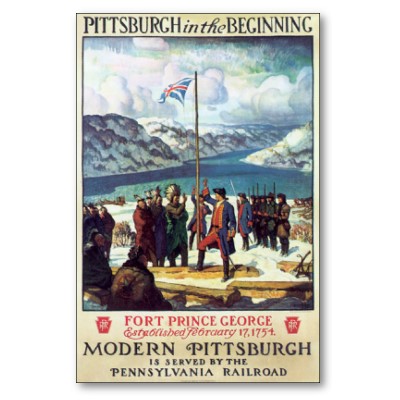
An interesting case is a 1930s travel poster for the Pennsylvania Railroad with the title “Pittsburgh in the Beginning.” The original artwork was done by N. C. Wyeth. The British began the construction of Fort Prince George in 1754, which when in April 1754 with the arrival of more than 500 French forces, was replaced by Fort Duquesne. The picture depicted the scene of a group of British soldiers planting their flag in front of native Indians. Perhaps a punch line here is indicated with the numbing wind (from the flag) and the throughout snow; thus PRR proudly says “Modern Pittsburgh is Served By the Pennsylvania Railroad.” Such a poster appeared in Swann Galleries in 2000 and fetched nearly $1,500.
If you are interested in vintage posters, do not miss the blog posts from the authority:
Blog of the Swann Auction Galleries.





Leave a comment