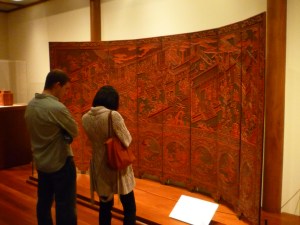
I’ve been cautioned on more than one occasion that the problem with buying Chinese lacquer is that you can’t easily date it. Carved lacquer objects have been produced in China since the Song Dynasty (960-1269). Before then lacquer was used for coating other materials. While most lacquer objects are red, that’s because red (cinnabar), along with black (carbon), are the most stable colors, it also comes in yellow (orpiment).
I came across Chinese lacquer twice recently, first in lamps being offered at Doyle at Home (lot 151), and second in a new exhibit at the Metropolitan Museum of Art, Cinnabar: The Chinese Art of Carved Lacquer.
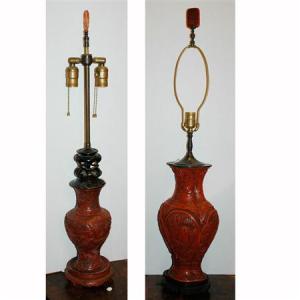
First I should note there were no lamps in the Met exhibit. Of course these lamps could have been made from vases that pre-date the lamps, or they could have been made to make you think that they could predate the lamps. We simply don’t know and Doyle doesn’t make any sort of assessment on their web site. In an adjacent room are the contents for a separate auction of fine Chinese antiquities from the collection of New York Mayor Hugh Grant and it would seem the lamps could have been included (I noticed some consignment objects that were not part of Grant’s collection in the auction), but they stayed with the Doyle at Home Sale. That may provide some clue as to whether they can be appreciated as Chinese antiquities.
In any case, most of the objects in the Met exhibit are on the small side and most are in the form of a box or a dish (although there is a very large lacquer screen from the 18th Century). They are made up of between 35 and 200 layers of lacquer. One incense box from the Yuan Dynasty has layers of yellow in between the red layers to provide depth.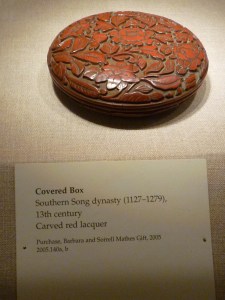
Commercial production of lacquer began in the late 16th Century serving merchants, scholars and even exporting to Japan in addition to serving the imperial court.
Today items dating more than 200 years are in general not permitted to leave China. That puts us in the Ming Dynasty. For reference Chinese Dynasty’s from most recent are: Quing Dynasty (1644-1912), Ming Dynasty (1368-1644), Yuan Dynasty (1271-1368), Song Dynasty (960-1271), Tang Dynasty (618-907) and Han Dynasty (206 BC-220). Time spans not identified are generally periods of disunity and commotion without an identifiable national ruler.
To be sure, if you set out to collect lacquer, there’s no easy task ahead of you. A quick look on ebay brings up a number of red lacquer objects, many originating in Tibet and likely to be new. If you have an opportunity to visit the Met exhibit, while it may not teach you to age an object, it should help you distinguish good carving from crude carving. If you look for lacquer as an antiquity, most of what you’ll find outside of China is from the Qing Dynasty. If you look at it for its artistic value, the skill of the carving is more important than the age anyway. Let your inner sense of beauty be your guide.





Leave a comment