
I must not be the only one, who, after aisles and aisles of walking in a large antique mall, develop an illusion that every booth looks similar. As a flatware collector, almost unconsciously I will begin to skip booths filled with colored glass bottles and stoneware. The latter are always tucked on the floor, near the corners so that people may not kick them over. Thus I seldom noticed them until very recently when the antique week and Maine Antique Digest brought out their auction values. I begin to wonder: Did I ever pass such ten-grand worth vessels? And I even begin to fancy that, perhaps next time if I look, I would pick up a humble looking one and make an antique roadshow purchase.
Nah, I need stop fancying and take one step back.
They say that beauty is in the eyes of beholder. Thanks for that, we don’t all rush to William and Mary or mid-century. Yet regardless of what collectors are looking for or whether they admit or not, rarity is one factor that consciously or unconsciously drives up the blood pressure and distinguishes an item from being mediocre or indispensable.
The question is: Would rarity dominate the desirability that marginalizes the aesthetic value?
The Americana, especially early Americana of utilitarian purpose, has seen some good years even though the general market is still floppy. Weathervanes, frakturs, Pennsylvania dower chests and New York stoneware have constantly made the news for being sold at astonishing sums. It sends you on a search through the attic or basement.
In the case of early American stoneware, I have learned from Leigh Keno’s website that flaws actually increase the value. “They attest to the crude and unpredictable conditions under which wares were made. Uneven firing temperatures, collisions in the kiln, and impurities in the clay produced interesting results: lopsided silhouettes, uneven tops, burn marks.” A few months ago, Crocker Farm auctioned one such stoneware for more than $40,000. What would the original owner of the clumsy vessel, who probably used it daily for cider or vinegar, think of the future buyer?
I have a mixed view about the early Americana objects.
On the one hand, their unsophisticated design is a far cry from modern sleekness and polished perfection. Not coincidentally, early Americana actually attracts more of a young crowd than more elegant Chippendale or Victorian furniture and objects. More importantly, American’s greatness lies in the passionate laymen, who from the beginning of the colony, went ahead with an assertive self-taught, problem-solving attitude to become ever-improving craftsmen that left the nation a legacy of physical affluence and mental certitude. Without them, there would have been no forthcoming higher-skilled indigenous artisans. For this, collecting early Americana is like collecting American spirit when it was just ignited.
On the other hand, I cannot relate such objects with their current market values. True, they were hand-made and always one-of-a-kind. But that is because the industrial revolution was yet to come. I respect people who collect stoneware based on regions and/or motifs. It takes time, patience and probably a lot of money to assemble a collection of early stoneware with American eagles painted in cobalt blue. No collection is trivial when collecting is focused and becomes scholarly-oriented. (Wouldn’t you want to identify the difference between the painted eagle from a New Jersey potter and that from a New York one?) Yet they were still daily-use vessels and their artistic values should not be over-estimated.
One of my friends, who is an artist, once said artists create artworks without knowing whether there will be a buyer. Art is the last thing people buy. People don’t buy art unless they have food and clothes. I tend to think such a statement somehow can be used to differentiate between fine art and decorative art although I am aware such a view is limited. (Copley didn’t paint without a buyer.) But the aesthetic value will be exerted to a maximum degree when artists or craftsmen are not obliged to create something intended for daily usage. Antiques have their own characteristics separate from find arts, but aren’t t we collectors looking for beauty ultimately?
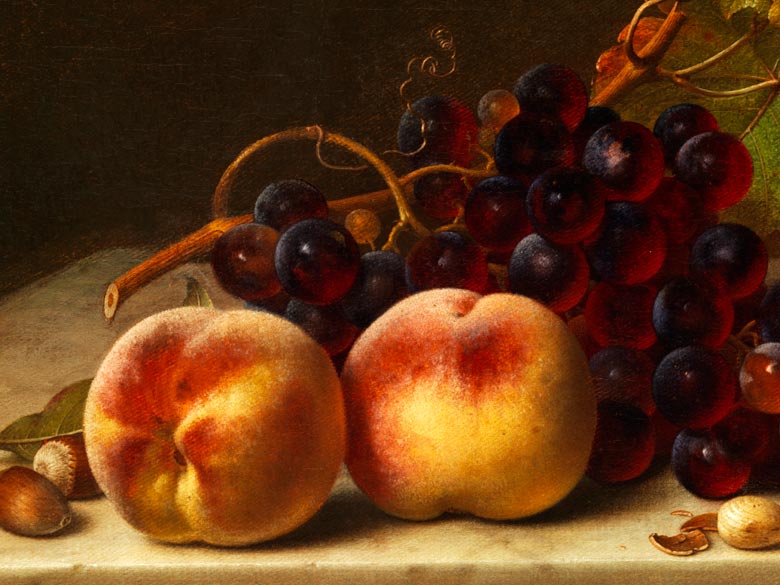
As this blog is written, I have found a still life painting by the master painter of Düsseldorf school Johann Wilhelm Preyer is up for auction. Preyer is a painter that I recently fell in love with from a trip to the Walters Art Museum. It is a tranquil picture of consummate skills and I would not move my eyes away if I could see it in a gallery. I begin to fancy again: If I had the money to buy between this one and an Americana stoneware with equal price, what would I choose?
The answer is meaningless since I couldn’t afford either. But at least seeing the picture of that record-high stoneware from the Crocker Farm auction made me in shock, while seeing the picture by Preyer gave me great pleasure and contentment.
Read previous articles in this series:





Leave a comment