In this series, Geo and I will list some of the interesting items that we have found in auctions, antique shops or eBay. We neither own the items and in most cases don’t have the capability of examining the items in person. It mainly serves as an inventory record of what interest us (not necessarily in terms of value or investment opportunities) and possibly how much it fetches (if the result can be obtained). If you are serious about some lots, please contact the auction houses, dealers or eBay sellers directly.
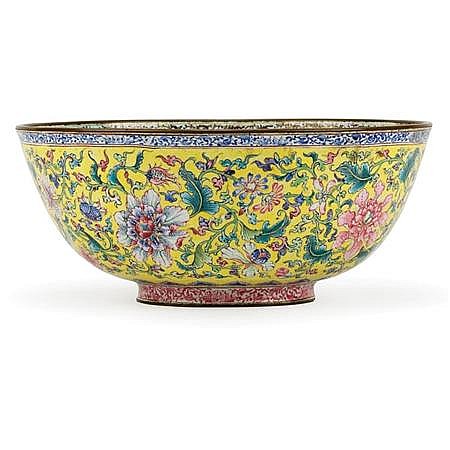
1. Doyle Auctions, Sept 14, 2009. Lot 63: Chinese Enameled Bowl
I am in general not a fan of rich palette and colors because there are too many forgeries in China’s antiques market good enough to fool amateur and even expert. Yellow in Qing Dynasty was reserved for royalty as was the dragon. But by the 18th or 19th century, the royal porcelain would have special markings. Thus I do not think this is from the royal palaces, although I will be just satisfied by the look of it. Inside the bowl, bats, peaches are both symbols of longevity, and there is a “SHOU” character (longevity) in the middle. All these and the sumptuous pattern suggest it may be made for a birthday present. I can imagine the pleasure of eating my long-life noodles out of it, although that would never happen if I were the owner of such a piece of artwork.
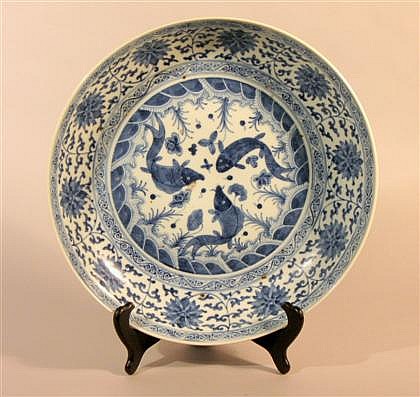
2. Freeman Auctions, Sept 14, 2009. Lot 540: Chinese blue and white porcelain charger, Qing dynasty, Of round, medium-deep form; decorated to interior with central aquatic medallio
The deep blue porcelain makes up for a lack of enamels by the exquisite patterns. Fish is a common motif for domestic porcelain because it has the same pronunciation of “surplus”. The design has a sense of flow that guides the viewers to move their eyes smoothly from curves to curves which ends at the bottom with three fish. Curiously, two of the fish are shown on one side while the third one is shown from the top view with both eyes looking out. Once the viewer has realized the minutia there, he can easily identify other nuances such as floras or grass, which are repeated, but with variation. Such a piece is always one of a kind. I wish I could be there to see and touch it.
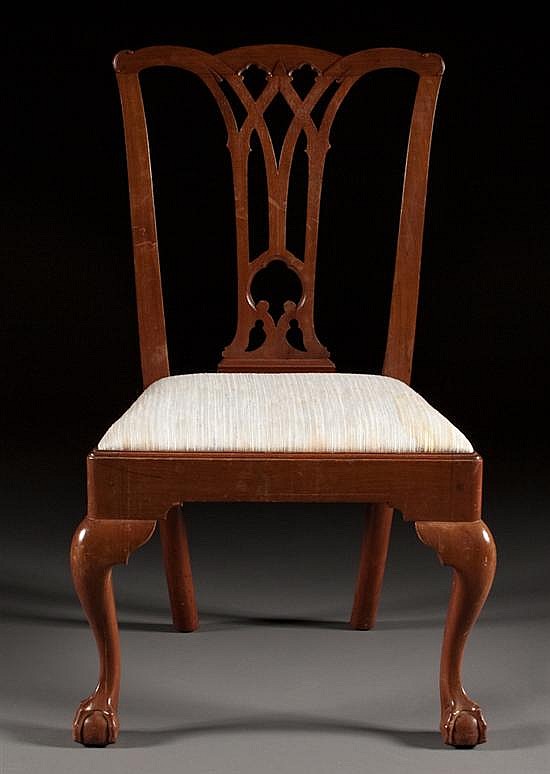
3. Alex Cooper Auctioneers, Sept 13, 2009. Lot 326: Chippendale mahogany side chair, Philadelphia
For a Chippendale side chair dated in the last quarter of the 18th century and made in Philadelphia, the estimation may seem a little bit low. Geo and I spotted one side chair from a dealer from York, PA at the Baltimore Antiques Show with an asking price more than $1,000. The ball and claw feet are beautifully carved, although the crest rail, according to the auction house’ description, may have been replaced.
4. Weschler’s, Sept 26, 2009. Lot 559: Abbie Luella Zuill (American 1856-1921), Still Life of Strawberries on a Garden Floor
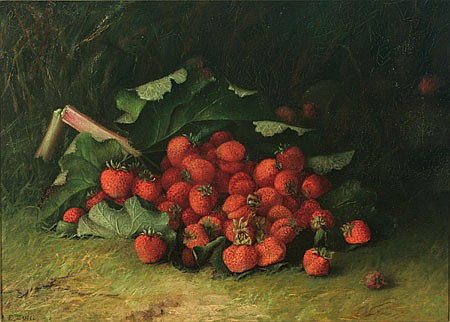
Abbie Zuill was the late student of Robert Dunning, the founder of the Fall River School. Her works often reflect Dunning’s late style with a soft, luminous light. This painting has a strong composition of strawberries, visually balanced by the deep green. It also produces an illusion of the momentary, and dynamics under the Ruskinian natural setting. Not only are the strawberries spilled out like nature’s bounty, but also the stem of rhubarb breaks seeminly reasonably, albeit contrived from the fruits. The “fruit” is fresh and ready, are you ready to “grab”?
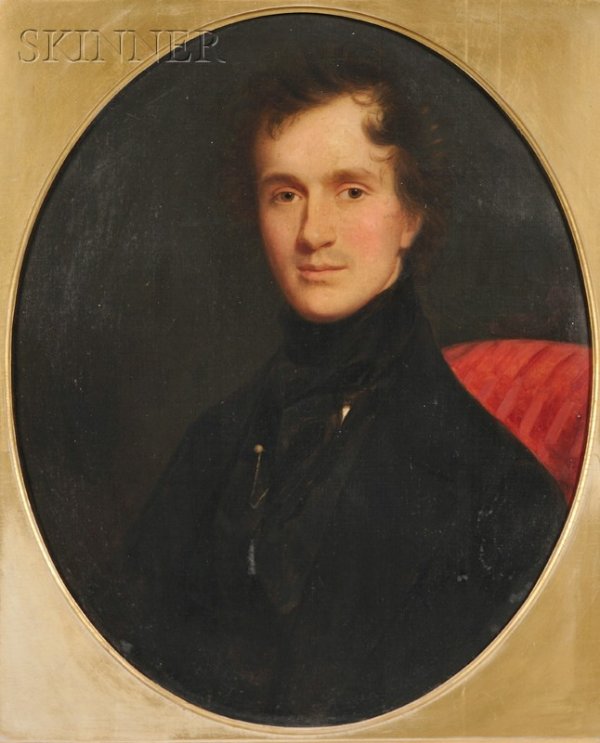
5. Skinner’s, Sept 11, 2009. Lot 422A: American School, 19th Century Portrait of Richard Varick
A portrait of a New York mayor is coming up for auction in Boston. Will a New York buyer bring him back to the city? Unsigned, with the sitter identified by the label on the back, at a minimum the painting offers a portrait of a handsome military officer by a hand of dexterous skills. Assuming the identification is correct, then Richard in the picture looks young and fresh and would be perhaps a decade before he assumed the position of New York mayor. In wikipedia.com, there is a image of his late portrait. Would New Yorkers be more happy to see a face of a mayor Bloomgerized with gray hairs and wrinkles? Well, at least I enjoy the exuberant youthfulness of this one.
6. Stair Galleries, Sept 12, 2009. Lot 164: American School, Full portrait of a boy and a girl
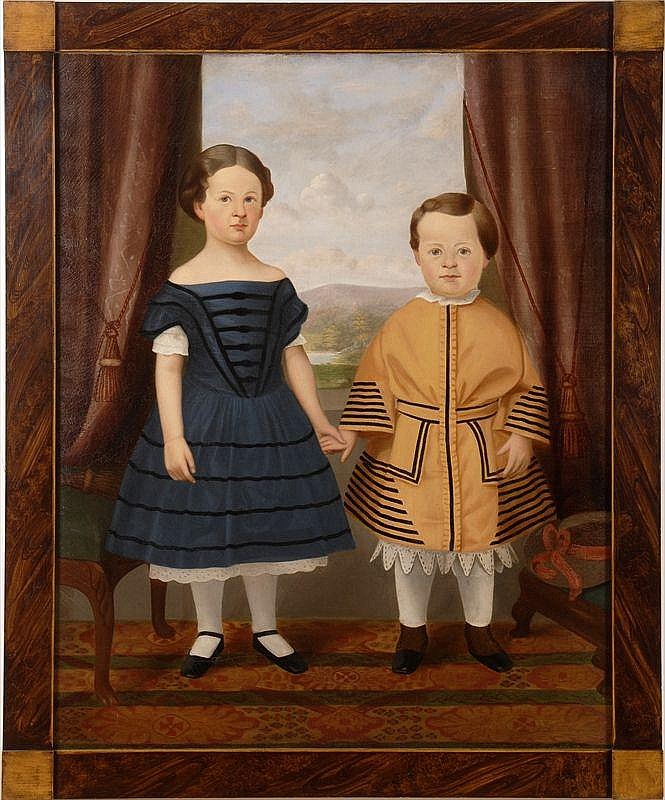
At the late of the 18th century or early of the 19th century, cities spoke loud of artistic progress (or fallacies) while countries preserved more or less the primitive nativity to suit a more conservative taste. If the flesh tone in the portrait of Varick betrays an English school influence, this portrait, slightly later than that of Varick, was probably done by an artist trained locally. The harsh edges give the two kids sincere, almost adult looks, perhaps based on patron’s preference. But the light pallete and balanced composition please the eyes. It is interesting to see that the artist gave the same detail-oriented exhaustive attentiveness to both the tassels of the curtain and the children’s hair although the latter was much more successfully done. Quite often, the itinerant painters paint part by part so the whole picture is an assembly of parts that were drawn from different sittings or prints. To me, the boy’s neck seems to be missing, but I am not sure whether it is because of the clothing or a mistake of the painter. But that adds the spice. So often you are stunned at a fluent portraiture that outshines a viewer’s wisdom, but in primitive portraiture, I can feel the struggle of the painters and may be able to trace how they attack the problems. Yet there is always some peculiarity that I feel strong and evident while words fails to describe, and that makes such a portrait a rewarding.
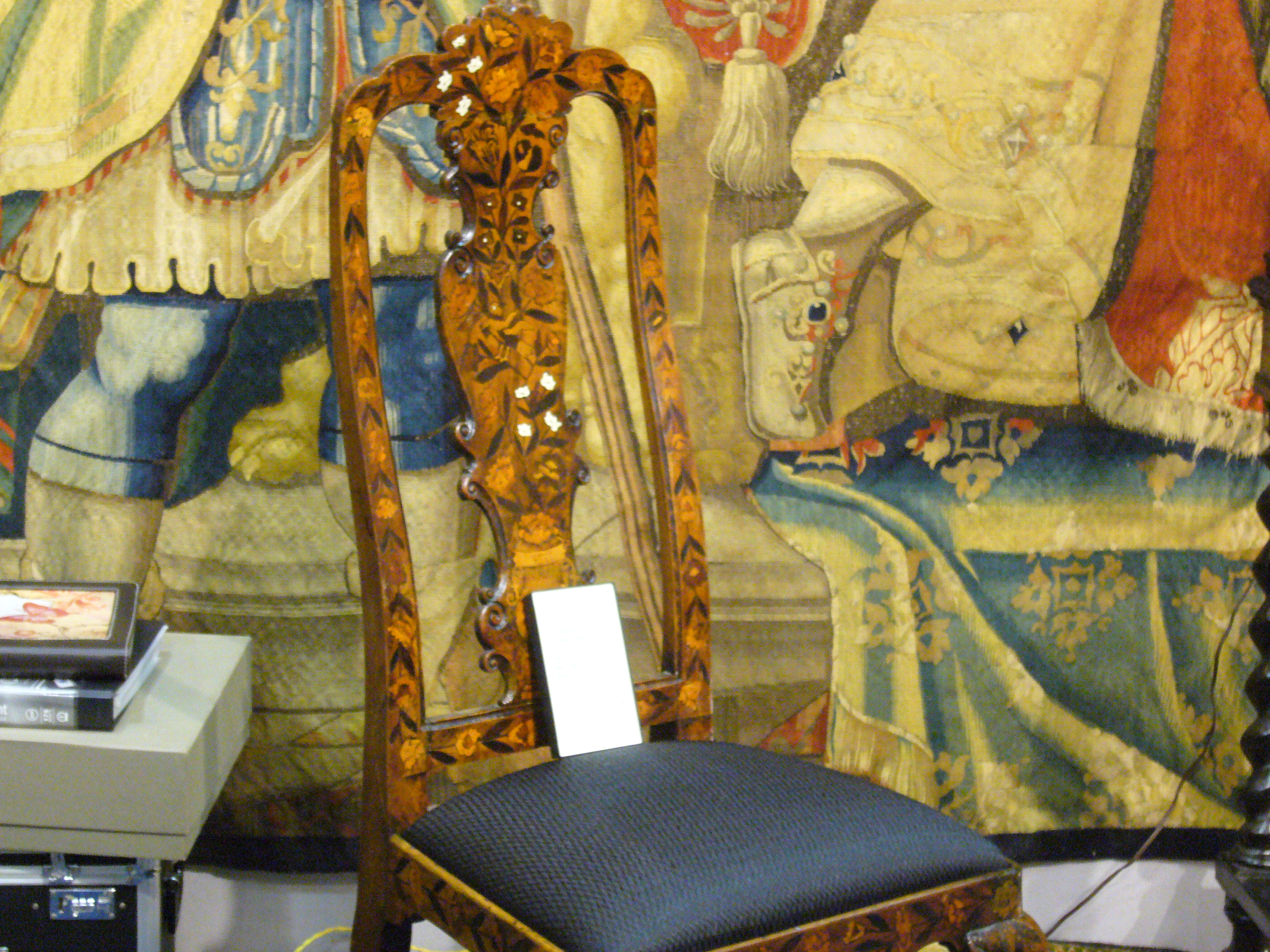
7. A Pair of Dutch Mahogony Inlaid Chairs
Some of the 18th century period rooms at Met feature imported Dutch or Dutch influenced “Japanned” furniture. But a pair of Dutch mahogany chairs from Douglas W. Morse Antiques at Baltimore Antiques show gave me an opportunity to examine them in person. For Geo, the chairs were too decorative to sit; but I was obsessed by the Dutch predilection for inlay. The turned scrolled-like stretchers are also more elegant (or more feminine) than the American counterparts. The “Jappaned” pattern carries out an oriental feeling of the age. Yet if actual Japanese patterns look succinct and reserved, the Dutch imitation fills motifs of flowers and birds into every inch of the splat. The feet of these Dutch chairs are different from typical pad feet: taller and thicker, bearing much of the William and Mary style. I was invited to sit on one of the chairs and noticed the seat cover was re-upholstered with haircloth fabric (or a horsechair). Its glossy sheen seems also durable, although I don’t like the stiffness of the fabric. (The fabric became popular in New York by 1820’s and would be a perfect choice for empire furniture. But I forgot to ask them where the reproduction was made). The asking price for these two chairs was $9000.





Leave a comment