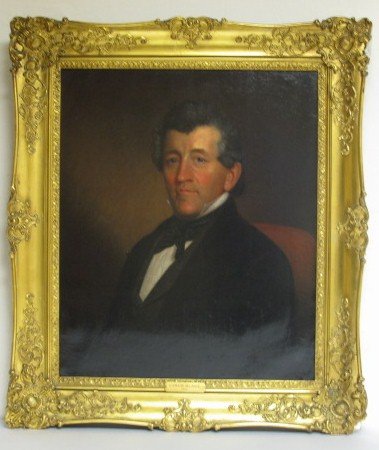
An early 19th-century portrait attributed to Gilbert Stuart heads Auctions Neapolitan’s sale July 25. Although the plaque identifies the subject as Cyrus Blake and is dated 1800, I have to suspect the reasoning of the article in liveauctioneers which claims that the frame is original. The heavily ornamental frame is more likely from after Stuart’s active period.
The bottom of the painting has lost some detail, which according to the auction house, was possibly caused by candle or fireplace heat. (But then it should NOT be called as in good condition.)
Although the description says it is believed to be painted by Gilbert Stuart, no further reasons or provenance is given. The article in liveauctioneers simply copied the first paragraph of the Wikipedia entry without referring to how the attribution was obtained. Coming back from Wadsworth Atheneum Museum where a couple of Gilbert Stuart’s paintings are hung at the beginning of the American Gallery on the second floor, I have come to prefer him to his predecessor Copley for his freer and bolder brushstrokes and glowing but not shining flesh tones. What Copley excelled with the elaborate costume and jewelry does not appear often in Stuart whose focus is always on the head. His broad treatment of clothes reminds me of Joshua Reynolds, but his signature style, in my mind, is the immaculate fluidity of the highlighted skin which sometimes looks as if floating away from the canvas. The layered translucent hues swiftly and lightly painted above an opaque underpaint for facial features give rise to more uncertainty than definite forte as if they would move at the moment of being viewed. There is more spontaneity in Stuart’s portraiture than pictures done by any other portrait painters of his generation or one generation later, yet I could hardly understand why I love them. Every time I try to examine the portrait in close distance, the skin tone that glows with the soul and personality simply disappear.
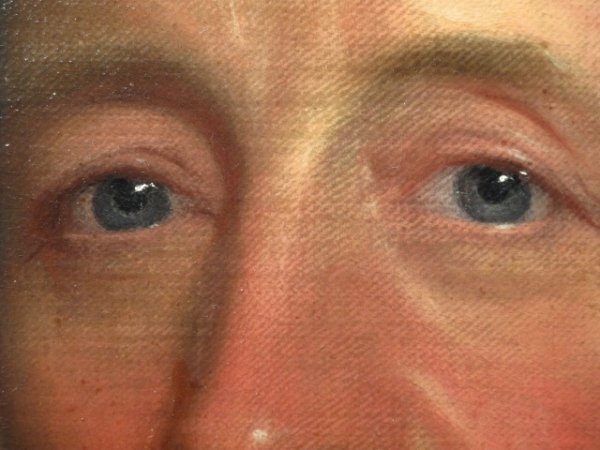
Such feelings of intricate likeness lacks in the painting of Cyrus Blake offered in the auction. In most of the Stuart’s painting, the wig can be identified immediately from the real hair which is painted with his signature swift brushstroke, but this portrait has more rigid hair that delineates instead of flowing. A close-up of the face shows a Stuartistic sensibility (in particular in the nostrils and the cheek), yet the range of the hues (especially in cool spectrum) seems limited and may indicate that it comes from a more conservative hand.
Since portrait painters in the Colonial period did not sign their names very often, the authentication should rely only on attributions by scholars of the field. In the case that neither names of the person who made the conclusion of the attribution nor the key points that lead to the attribution is given, I simply can only accept it as a good portrait by a skilled artist with the advantage of knowing the sitter’s name. With an estimated price of $8,000 to $12,000, the bidders under the current market may or may not be enthusiastic for the attributed work.





Leave a comment