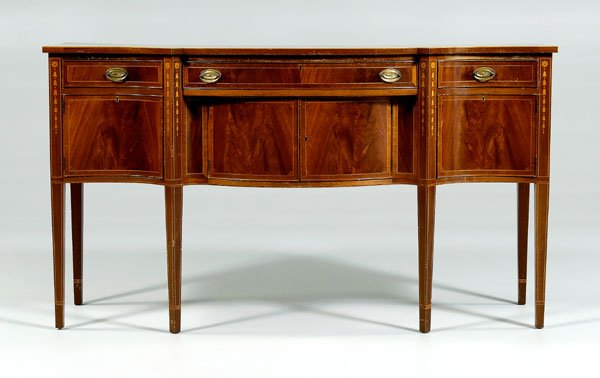
It can be difficult to authenticate a piece of furniture in person and so identification from a photo online can be completely problematic. Still we can’t help but wonder from time to time if something is really period, or if something thought to be out of period is actually older. Brunk Auction’s is offering a sideboard labled as 20th Century construction that I thought for a fleeting moment looked period. It’s certainly similar in form and size to 18th Century sideboards, and details show some convincing inlay. We don’t have a lot to go on by the photos, however. The sides of drawers are a good place to start. The wood on the drawer side looks like it might be oak, for example, indicating a 20th Century piece of furniture. Had it been period, secondary wood is likely to have been pine.
- Nails and Screws: Before 1790, nails had irregular shaped heads. Varieties of square nails were used from 1790-1890, when modern brad nails were introduced.
- Hand Planing: Furniture before 1850 had hand-planed back boards and drawer bottoms. Run your hand along the bottom of a drawer for clues in texture.
- The Circular Saw: The circular saw was not in regular use until after 1830. Circular marks are an indication somethhing was produced later.
- Wood Shrinkage: Wood shrinks opposite grain. Problems with veneer might be unattractive, but can be a sign of age. Circular table tops will have shrunk to be slightly oval shaped. Use a tape measure to measure an x across.
- Knotty Pine: It’s presence is a pretty good sign a piece of furniture is not very old.
I should add that should you want a nice sideboard, whether this one is period or not isn’t pertinent. The price seems in line for a reproduction, and you’ll win on character and quality over a sililar-priced modern-day piece.
Link to the item
UPDATE: Estimated at $1,000-$2,000, this lot sold for $950, plus premium.





Leave a comment