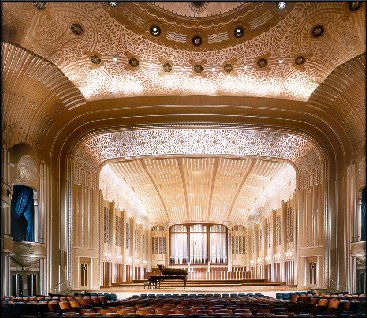
On the way back from a visit to Severance Hall, Cleveland OH, fog rolled in from the lake-like walls of one thousand veils. Suddenly, the air became weighty. I could not only breathe but also feel or touch it. Every skyscraper faded away, bringing the roads, only the roads to the center of the consciousness.
Euclid Avenue, the once wealthiest avenue in American history, has become a bumpy road sparsely filled with rows of newly-built condos and office buildings. Only eight mansions survived the turbulent Hough Riot in 1966. Luckily, Severance Hall, at the other end of the road, survived through those nights with unrelenting fire alarms.
Severance Hall was built in 1931, only twelve years junior to the Cleveland Orchestra. Artur Rodziński was the first conductor on the stage. But it was George Szell who left his mark permanently in the music hall. Even though, unlike the other bigger cities such as New York and Chicago, Cleveland didn’t have city blocks named after its legendary maestros, George Szell’s influence on Cleveland is tremendous not only because he brought the middle-west medium-sized industrial city a world-class orchestra with pedigree European blood, but also because he changed stage shell physically in order to improve the acoustic result.

Although the exterior of Severance Hall was designed to complement the Art Museum in neoclassical form, from the entrance lobby to the auditorium room, the style gradually transitions to Art Nouveau and Art Deco. In 1958, when facing the trade-off between aesthetic beauty and acoustic integrity, George Szell sided with the latter, putting his famous “Szell shell” over the stage which visually confronted the Art Deco interior. Today those ugly modern Szell shells have been replaced by material both visually and acoustically satisfying. But most of all, the glory and the history of the architecture are preserved with the ever-growing orchestra. Concertgoers, when entering the grand main lobby and seeing the restored shimmering golden hall, will surely agree with Alburn’s assertion that “Severance Hall is one of those singular and complete triumphs which come to an American community infrequently, if ever”.
Pittsburgh was not that lucky.

In late August of 1994, Syria Mosque, the original home for Pittsburgh Symphony was demolished when a group of activists were still protesting in front of bulldozers. Among them, Sen. Jim Ferlo spent a night in jail for his last effort. He almost won this brutal battle because the demolition permit was obtained only two hours before the building’s historical landmark nomination.
Although most agree that relocating the orchestra to the Cultural District of the downtown area is a wise move, it was surprising to know a building that cost $750,000 in 1916 would be torn down in modern times. It is true that Syria Mosque is huge and the sound is muffled in the oversized music hall, but there was no reason that under scientific study such problems cannot be solved. If fact, Penn Theatre was scheduled to be demolished if Henry Heinz hadn’t stepped in and donated ten million dollars to preserve its Baroque and Rococo style and transformed it into Heinz Hall. The same money could have been used to hire Dr. Heinrich Keilholz, who directed the Heinz Hall transformation project, to improve Syria Mosque’s acoustics.
Syria Mosque saw the growth of the Pittsburgh Symphony Orchestra, from Fritz Reiner to William Steinberg, the latter, through decades, nurtured the orchestra to a world-class level. After the orchestra moved to Heinz Hall in 1971, Syria Mosque still held a lot of pop concerts and attracted a vast amount of audience.
The raze of Syria Mosque can be regarded as a scandal resulting from a shortsighted politician and an ambitious University that has been seeking to expand ever since. Lorin Maazel, who graduated from the University of Pittsburgh and was the music director in that turmoil period, saw the fall of the temple. To what extent his reaction was is hard to know, but in the same summer, he declared that he would not renew his contract after the 1996 season. A city that didn’t honor and treasure its glorious past can’t stand tall for its future.
More than 10 years after Syria Mosque was demolished, I walk by the UPMC parking lot, where the temple used to be, almost every day. Oakland, as the cultural and educational center of the city, has lost its architectural integrity and has been disfigured by the ugliness of the land-wasting seas of the parking lot.

More than 50 years ago, it was at the site of this parking lot that the unsurpassable Beethoven and Brahms violin concertos with Nathan Milstein were performed. It was a mono-recording. The sound captured reflects the amplitude of the Syria Mosque vividly. Under Steinberg’s baton, there was a sense of pressing and forwarding, but the orchestra still kept its fluidity and flexibility. At the beginning of Beethoven’s violin concerto, timpani stretched far and deep and the reverberation of the string sections was held long like ocean waves. Then Milstein’s violin pierced through the stage, roaring in the air like an independent spirit, uninhibited.





Leave a comment