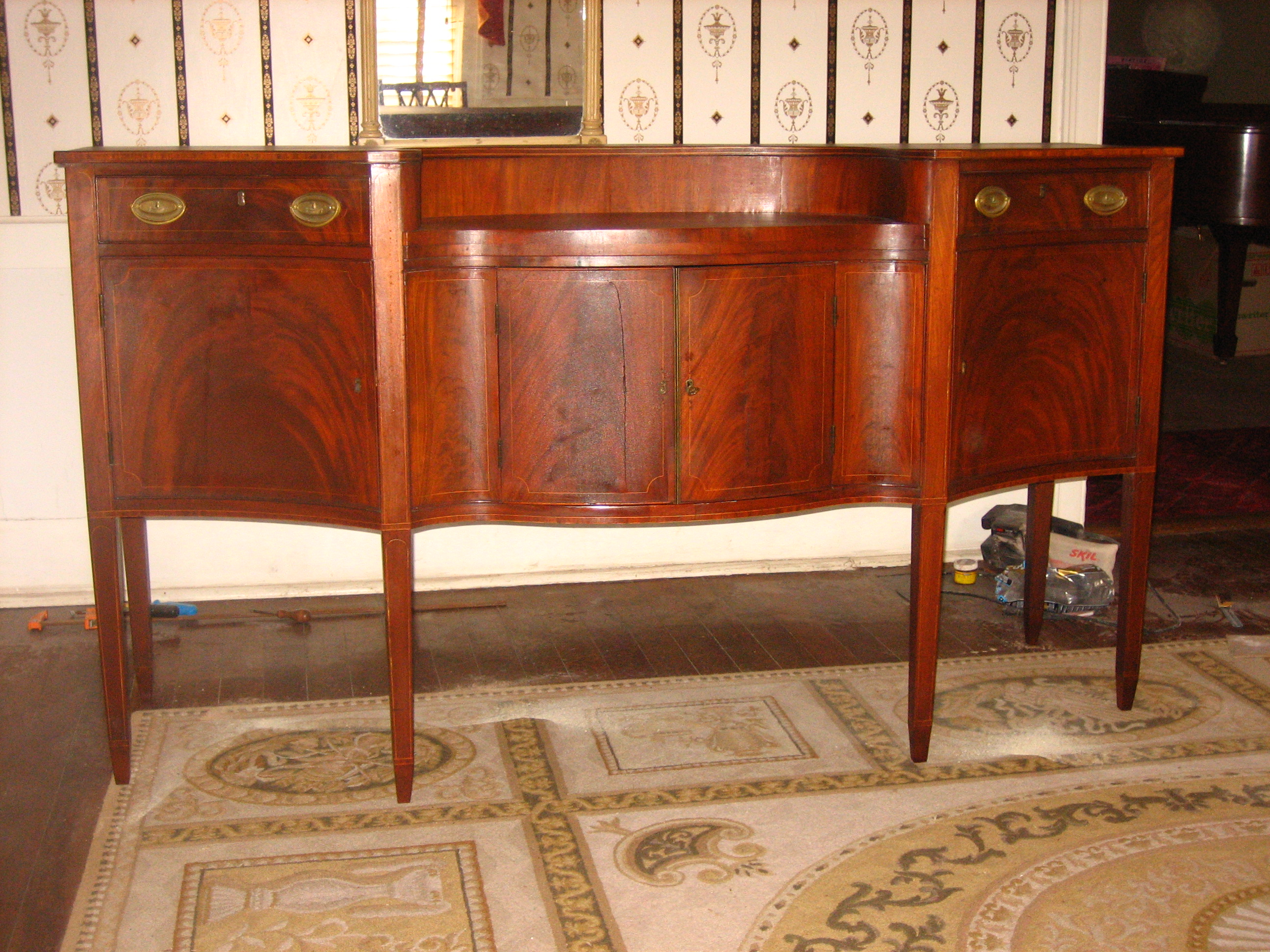
A thing may not be what it appears. That doesn’t hold true for the current physical form of an object as much as it does for how it got that way. The story of a sideboard dating to Federal-era Boston serves as a good way to demonstrate this idea.
Not much verbal information was offered with the purchase of a graceful, sophisticated sideboard in suburban Michigan. The complex, fully developed form had unusual characteristics. A shelf, just above the central cabinet doors, looked custom-made for perhaps an elaborate silver tea service of the period. This sunken area of the top made the sideboard a curiosity for all who saw it. Further research supported the indication of “unusual,” as few American examples of this form with two-tiered tops could be found. Contact with experts in the antiques industry supported the notion of the form is highly unusual. “I’ve never seen anything like it,” was echoed repeatedly.
At the time of purchase, a screw holding the top to a backboard of the sideboard was removed in an effort to determine if and when the top had been removed. The screw was of undeniable early manufacture and seemed to fit its hole tightly enough to be original.
Although provenance was not forthcoming from the seller, several clues were provided. A manila envelope postmarked 1937 which conveyed with the piece, contained a photograph from that period showing the sideboard. The return address was the Colonial Williamsburg Foundation, but the name of the recipient had been blacked out. On the envelope’s reverse was a New York City address with the cryptic handwritten words, ” . . . who is a great expert on early American furniture.” Research showed that the address was that of Israel Sack’s New York store in the latter 1930s.
The sideboard’s seller also offered a fully functional c. 1815 Boston pianoforte and artwork from the same period stating that these items were from the same house as the sideboard. The items appeared to have been owned by the same family for many years and suggested definite New England origins.
The clues to the sideboard’s past brought many questions. Who had owned the sideboard in 1937? It appeared that someone with the Colonial Williamsburg Foundation had thought well enough of the piece to refer the owner to Israel Sack. Had the unusual form been a warning to both the owner and contemporary antiques experts in 1937, as it had become for us in 2006?
My business associate, an Ohio antiques dealer, took the sideboard to a prominent antiques show, and the possibility was raised that a middle drawer may have been removed to construct the shelf previously described. Initial impressions made this seem unlikely. The center cabinet doors were lower than the outer doors, suggesting that the shelf had always been a part of the sideboard. Further, the complicated, undulating curve of the shelf’s gallery seemed very costly and complex for a later adaptation.
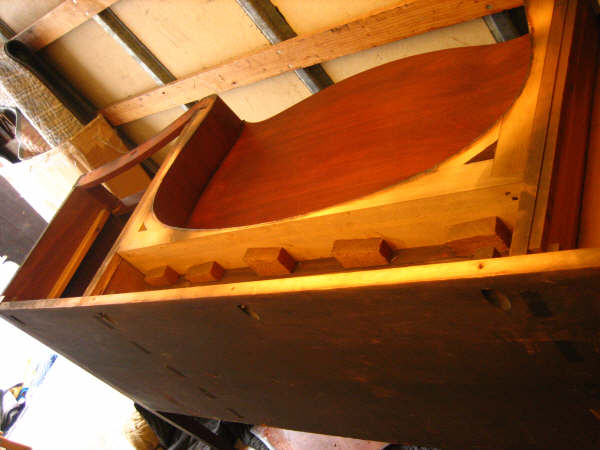
This made the idea of a Victorian alteration by a careless owner seem unlikely. If such an adaptation had been made, it is difficult to imagine the results being in the graceful and meticulous form of the shelf and gallery. Furthermore, the finish on all parts of the sideboard appeared uniform and very old, if not original. Painted floor cloth of the Federal era still lined cupboard bottoms, undisturbed.
Yet several factors began pointing to the fact that the sideboard may have originally have had a center drawer. String inlay, which wraps around three sides of the top, is missing the detail of contrasting center veneer once the curve of the gallery begins. Was this done as a shading effect, or does it signify an alteration? The unusual double stile under the shelf began to seem heavy and ponderous for such a graceful and sophisticated piece.
The conclusion was that the only way to know the sideboard’s true history was to remove the top. While one hates to turn screws which may have been in place for two centuries, persisting doubts about the originality of the lowered shelf and gallery made it a necessity to do so. When the top came off, it was revealed that the shelf was indeed an adaptation, albeit one made by a very skilled craftsman early on. Hand made screws and square nails confirmed this. Differences in wood, wood coloration and drawer stops without purpose confirmed the idea of an intended center drawer.
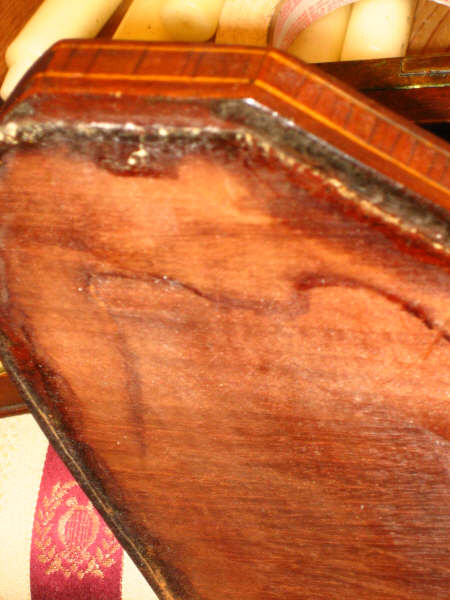
As is often the case with these investigations, additional information raised as many questions as it answered. While we are now certain that a top drawer was the original maker’s intention, how early in the life of the sideboard had the drawer been removed, and why, still mystified us. Had a last minute change of plan nixed the drawer before the sideboard was delivered, or had some early damage made an alteration necessary? Could it be that the sideboard’s owners, who cared so well for their pianoforte, had damaged the top drawer and decided on the shelf rather than a more conventional repair?
From Boston to B. W. Avery
While we weren’t able to determine which Boston shop made this unusual sideboard, we do have some clues as to the person for whom it was commissioned. Yellowed paper labels, some hastily torn in an effort to efface them, read “Avery,” an early Massachusettes family of some renown. Twentieth-century Michigan boasts well-known “Averys” as well, but genealogical records searched haven’t yet made a positive tie between the sideboard’s more recent owners and John Avery, the eighteenth-century Massachusettes Secretary of State from Boston.
The mystery of this highly unusual sideboard continues to unravel.





Leave a comment