http://www.urbanartantiques.com/wp-content/uploads/2009/01/whathathgodwrought.wmv
In 1815, most Americans were the subject of “a tyranny of distance,” as writer Daniel Walker Howe put it at an event this weekend sponsored by Brooklyn’s Green-Wood Cemetery. Howe is author of “What Hath God Wrought,” a book that chronicles the changes between 1815 and 1845. Many of the men who brought those changes into being are buried in Green-Wood.
Howe said that in 1815, the state of things in the United States were such that if it existed today, it could be called a “third-world country.” One of the current residents of the cemetery, Samuel Morse, set change into motion when the words “What Hath God Wrought” were transmitted by telegraph. The invention, which can be compared to the impact of the internet in our own time, facilitated the growth of newspapers and large political parties.
In fact, had the invention existed before 1812, the war named for the year would probably not have occurred.
When the gold was discovered in California in 1848, the message traveled to China and Latin America before it reached New York and Europe, because telegraph cables hadn’t yet reached California. The first message in “Morse Code” went across the Atlantic to England in 1858.
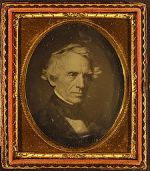
- Morse Daguerreotype

Morse was better known in his own time as a prominent artist and painter of prominent figures including President Monroe. When he failed to secure a commission to paint the interior of the U.S. Capitol Dome, he traded a career in art for one in invention. On a trip to Paris, Morse met Louis Daguerre, another inventor who might have hindered the career of artists in those days. Daguerre, also buried in Green-Wood, is recognized today as the father of photography.
The photo with the audio clip above shows Forward the Course of an Empire Takes Its Way by Currier and Ives. I recognized it immediately from grade school history books and from a framed print my grandmother had. Both Currier and Ives are buried in Green-Wood. Howe said it would have been the cover of the book had it not been produced in 1866, after the period of time covered by the book.
The lecture was preceded with a trolley-bus tour of the cemetery, guided by Green-Wood historian Jeffrey Richman, author of the also excellent book Brooklyn’s Green-Wood Cemetery, New York’s Buried Treasure.





Leave a comment