It was a wonderful afternoon in the peaceful Green-Wood Cemetery. Prof. Daniel Howe gave a lecture about his Pulitzer awarding-winning book What Hath God Wrought, followed by Jeff Richman‘s trolley tour about the important people of the same period (1815-1948) buried in the rural cemetery of that time.
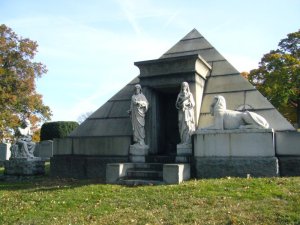
The trolley meandered the winding roads no faster than the speed of a leisure walk. Then I saw the tomb chapel that had stuck with me last time: an Egyptian Revival tomb mingled with Christian themes.
I didn’t have the chance to get off the trolley to look at this tomb closely. Sure it has a pyramid shape, the winged sun goes under the eave, sure the statues in the front of the entrance are reminiscent of Gigantic statues in the New Kingdom like those in Ramsesseum. There is even a sphinx on the left with the head of a pharaoh. But to anyone who has read about Egyptian arts and history, it is just a mere reflection of Christianity in the guise of Egyptomania. There are small details that just bother me. For example, the position of the sphinx is on the left side of the door which is in general considered less important (or from another angle, the asymmetry is destroying the Ma’at). Similarly, the tail is curled up from the left of the body which would probably not appear in real Egyptian antiquity. Most of all, there is Joseph, Mary, and Jesus that stand prominently so that no matter how the eyes of visitors may be busy grasping details here and there, they will eventually focus on these groups of statues.
This reminds me of the upcoming exhibition “Unearthing the Truth: Egypt’s Pagan and Coptic Sculpture” in the Brooklyn Museum starting on Feb 13, 2009. Museums are not immune to forgeries, but to a great extent, they could avoid it when equipped with scholars and curators with in-depth knowledge of the fields. But from the 1950s to the 1970s, when large quantities of Coptic art with overly stated Christianity symbolism came up to the antique market, scholars didn’t question their authenticity of them, instead embracing them to support their publication of Coptic Christian origin.
This was not the first time, nor will be the last time when social science study fails because of the biased foundation upon which it is based. It happened when the researchers tended to have more or less homogeneous social and racial backgrounds: white, male, and Christian. The Victorian self-centered egoism in the research attitude may have receded to a great extent by then, but the influence took a longer time to die out. There is nothing wrong about looking for evidence diligently to support conjectures/hypotheses beforehand, yet without delving deep and broad in the field such conjectures and hypotheses are ill-fated at the beginning.
Of course, it would probably not happen today. Long gone of those free antique markets when provenance was not a big concern. Those shrewd dealers may sense the demand for certain styles or subjects in the 1950s, but they would not be able to pass the customs nowadays with anything substantial in their pockets.
On the other hand, the Brooklyn Museum is making a bold and innovative approach to exhibiting its collection. Instead of hiding the forgeries in the storerooms, they are going to show them and tell the public the story from a history of Egyptology point of view. It serves well for both general visitors and in-field scholars. In particular, Egyptology is a field of vast topics and time span with a large number of controversies and contradictory theories.
Without getting rid of colored glass, we may be fooled again in the future. We must not! The Victoria nicety and Eclecticism are appropriate for the final resting places, yet unearthing the truth is all we sought in the scientific and museological study.
——————————————————-

Left is another example of an Egyptian Revival tomb in Homewood Cemetery, Pittsburgh, PA. This one features papyrus cluster columns.





Leave a comment